The Knowledge Navigator
Abstract
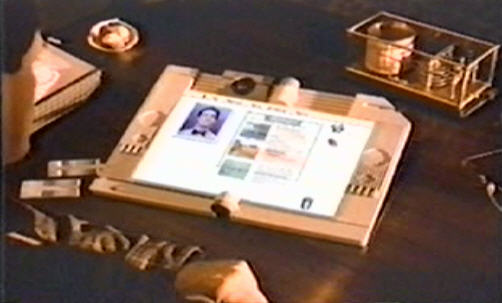
In 1987 Apple made a short film for John Sculley’s keynote at the EDUCOM conference: a university professor at a foldable tablet talks to an animated software agent, a butler-like figure who manages his schedule, finds papers, and sets up a video call with a colleague. The Knowledge Navigator video took about six weeks and $60,000. Apple never built the machine. The Newton and General Magic tried parts of it in the 1990s and failed; Siri, which Apple announced on 4 October 2011, delivered the talking assistant almost exactly at the date the video appears to be set in. Two of Siri’s founders then started Viv to build the open, plug-in assistant the video had shown, and sold it to Samsung in 2016, where it became part of Bixby.
A Keynote for EDUCOM
John Sculley described the Knowledge Navigator in his 1987 book Odyssey: Pepsi to Apple, written with John A. Byrne, as “a discoverer of worlds, a tool as galvanizing as the printing press.” The film came out of Apple’s higher-education marketing, run by Bud Colligan, which needed a keynote for EDUCOM, the main computing conference for universities and a large market for Apple. The talk had three parts: what students were doing with Macintoshes now, research Apple was funding at universities, and a look further ahead.
Hugh Dubberly and Doris Mitsch of Apple Creative Services wrote it, with technical and conceptual input from Mike Liebhold of Apple’s Advanced Technology Group and advice from the Apple Fellow Alan Kay, whose Dynabook was the obvious ancestor. Gavin Ivester of Apple’s product design group designed the device. The Kenwood Group in San Francisco produced it and Randy Field directed; by Field’s account it was shot in a single day in a house in San Francisco. Dubberly later gave the schedule as about six weeks to write, shoot and edit, and the production budget as about $60,000. For research the team talked with the interface designer Aaron Marcus and the forecaster Paul Saffo, drew on earlier visits to MIT’s Architecture Machine Group, and read Stewart Brand’s book on the Media Lab, William Gibson’s Neuromancer and Vernor Vinge’s True Names.
The Film
A professor opens a folding tablet on his desk and the agent appears in a window, an animated butler-like figure who goes through his messages and schedule and helps him prepare a lecture on deforestation in the Amazon: on request it finds a colleague’s paper, pulls in data, shows a simulation, and places a video call to her so that they can work on it together. The professor talks; the agent answers in speech. The device has a touch screen, a camera and a network connection, and the information comes from linked databases around the world in what amounts to hypertext.
Dubberly explained the agent as a narrative device as much as a prediction: a character who speaks lets a film explain what the machine is doing, and made clear the piece was science fiction. The professor’s calendar shows Wednesday, 16 September, and he asks for a paper published “about five years ago” in 2006, which puts the scene in September 2011. In October 2011 the blogger Andy Baio noticed that Siri had been announced on the 4th of that month, less than three weeks later. Commenters pointed out that 16 September fell on a Wednesday in 2009 and 2015, not 2011, so the film’s dates may not have been checked against a calendar. The video spawned half a dozen or more sequels inside Apple, among them Project 2000 and Healthcare 2008 (both 1988), and other companies made similar films.
Pieces of It at Apple and General Magic
Apple tried to build parts of the vision under the same chief executive. The Newton project started in 1987, the year of the film, as a pen-driven handheld, and Sculley announced it in January 1992 with a new phrase, “personal digital assistant”. It shipped in 1993 and was cancelled in 1998. In 1990 Sculley let another internal project, Marc Porat’s Paradigm, leave Apple as General Magic, whose communicators had software agents that ran errands across a network. Neither offered the spoken conversation, the video or the database search the film showed.
The idea had an older ancestor. In April 1968 J. C. R. Licklider and Robert Taylor described an assistant they called OLIVER, an “on-line interactive vicarious expediter and responder” named after Oliver Selfridge, who had originated the concept, in “The Computer as a Communication Device”: “‘You are describing a secretary,’ you will say. But no! Secretaries will have OLIVERS.”
Siri and Viv
The assistant that did reach the public came from a DARPA research programme at SRI International, CALO, and the start-up Siri Inc., founded in 2007 by Dag Kittlaus, Adam Cheyer and Tom Gruber (see The Voice Assistant Revolution). The Siri app appeared in February 2010, Apple bought the company in April 2010 for a reported $200 million, and Siri was announced with the iPhone 4S on 4 October 2011. Steve Jobs died the next day. Apple’s Siri was a closed system: it worked with the services Apple chose to connect.
In 2012 Kittlaus and Cheyer, with Chris Brigham, founded Viv Labs to build what Siri had not become: an assistant that third-party developers could extend, and that would assemble a program on the fly from the services it knew in order to answer a compound request. Viv raised about $30 million by 2016 and showed the system in public for the first time on 9 May 2016 at TechCrunch Disrupt in New York. Samsung bought Viv Labs in October 2016, and its technology went into Bixby 2.0, Samsung’s assistant, in October 2017. In 2013 the Computer History Museum recorded an oral history with the Siri founders, released in 2024.
Dead End
The Knowledge Navigator was a film, not a product plan, and Apple never claimed otherwise. Of what it showed, the tablet, the touch screen, the video call and the networked library all arrived within about twenty-five years, most of them through companies other than Apple’s 1987 management. The agent was the part that lagged: Siri in 2011 could answer and dispatch, but could not hold the professor’s conversation, and Viv’s open version was absorbed into Samsung’s assistant and disappeared as a separate idea. Conversation of the kind the film scripted came only with the large language models of the 2020s; see also Chatbots Before ChatGPT.
📚 Sources
- Hugh Dubberly, “The Making of Knowledge Navigator”, Dubberly Design Office, 30 March 2007 (first published in Bill Buxton’s Sketching User Experiences, 2007; the EDUCOM keynote and its three parts, about six weeks, about $60,000, the team including Liebhold, Colligan, Mitsch, Field, Ivester and the Kenwood Group, Alan Kay’s advice, the research (Marcus, Saffo, the Architecture Machine Group) and reading list, the agent as narrative device, half a dozen or more sequels)
- Knowledge Navigator — Wikipedia (Sculley and Byrne’s Odyssey and the “printing press” quote, the 1987 date, Project 2000 and Healthcare 2008 in 1988, the Amazon deforestation scenario, Dubberly and Mitsch with Liebhold)
- Andy Baio, “Apple’s 1987 Knowledge Navigator, Only One Month Late”, Waxy.org, October 2011 (the 16 September calendar and the 2006 paper, Siri’s announcement on 4 October 2011, Randy Field’s comment on the one-day shoot, the calendar objection)
- Secrets of Siri, Computer History Museum (OLIVER and the Licklider and Taylor quote, the Knowledge Navigator set in 2011, Siri’s founders, Viv Labs founded 2012 by Cheyer, Kittlaus and Brigham, Samsung and Bixby, the 2013 oral history released in 2024)
- J. C. R. Licklider and Robert W. Taylor, “The Computer as a Communication Device”, Science and Technology, April 1968 (PDF)
- Viv (software) — Wikipedia (development from 2012, $30 million raised by early 2016, demo on 9 May 2016 at TechCrunch Disrupt New York, Samsung’s acquisition in October 2016, Bixby 2.0 in October 2017, the open plug-in architecture)
- Image: Knowledge Navigator.jpg by KenwoodSF (CC BY-SA 3.0), via Wikimedia Commons