The Teletype ASR-33
Abstract
The Teletype Model 33, introduced in 1963, was a cheap, light-duty teleprinter: a keyboard, a typewheel printer and, in the ASR version, a paper-tape punch and reader, all working at ten characters per second. It was one of the first machines built around the new ASCII code, and because computer makers could buy it for about $700, it became the standard console and terminal of the 1960s and 1970s: on DEC minicomputers, on the time-sharing systems where students learned BASIC, at Bell Labs where Unix was written, and beside early hobby computers such as the Altair. More than half a million were made by 1975. Its habits survive in computing: the name tty, the two-character line ending CR LF, the shortness of Unix commands, and the @ in email addresses.
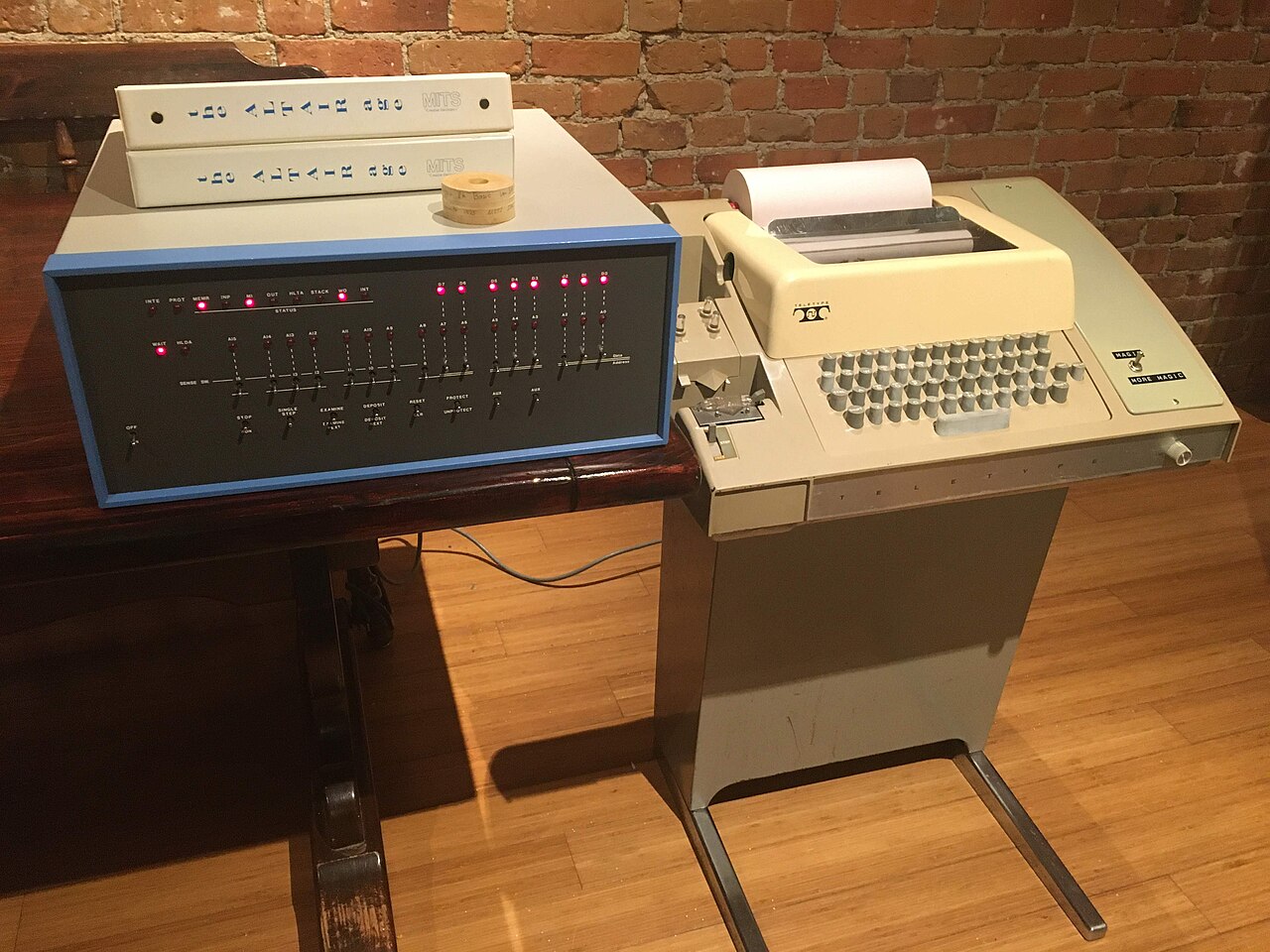
A Cheap Teleprinter
The Teletype Corporation of Chicago, named in 1928 and descended from the Morkrum Company, which had installed its first commercial teleprinter line in 1910, had belonged to AT&T, as a subsidiary of Western Electric, since 1930 (see Data Communication Prehistory). Its heavy machines ran for years in news agencies and message centres. The Model 33 was the opposite: an all-mechanical design with many plastic parts, intended for light office use of up to about two hours a day. Wikipedia’s account says it was first designed for the US Navy; the Computer History Museum says it was designed as a low-cost terminal for the Western Union network. It went on sale in 1963, the year the American Standards Association published the first version of ASCII, and it used the new seven-bit code plus a parity bit, where earlier teleprinters had used five-bit Baudot codes.
Three versions were sold. The RO (receive only) was a printer, the KSR (keyboard send-receive) added a keyboard, and the ASR (automatic send-receive) added an eight-hole paper-tape punch and reader on the left side, so a message, or a program, could be prepared offline and sent at full speed. The machine printed ten characters per second over a 110-baud line, in capitals only; the keyboard had no lower-case letters and lacked several characters later added to ASCII, among them the curly braces, the vertical bar and the tilde. An answerback drum let a remote machine ask “who are you?” with the WRU code and receive an identification without anyone touching the keyboard.
New machines cost about $1,000 in the mid-1960s; the Computer History Museum gives about $700 as the price to computer makers who bundled it with their systems, and in 1976 a new receive-only Model 33 cost about $600. Teletype built the heavier Model 35 for continuous use, at a higher price. Over half a million Model 33s had been made by 1975, another 100,000 followed in the next eighteen months, and Teletype ended production in 1981.
The Terminal of Time-Sharing
The price made the Model 33 the default console for minicomputers such as DEC’s PDP-8, and the default terminal for time-sharing systems, where dozens of users shared one machine over phone lines (see Fernando Corbató and Time-Sharing). Kemeny and Kurtz designed BASIC at Dartmouth in 1964 for students typing at such terminals, which is why early BASIC was all capitals and terse (see Fun Fact: BASIC’s Origin). In 1968 the Lakeside School in Seattle bought time on a commercial time-sharing service and put a Model 33 in a room for its pupils; it was Bill Gates’s first computer (see Paul Allen and Microsoft). In 1973 a Model 33 in a cardboard box in a Berkeley record shop became Community Memory, one of the first public bulletin boards (see Lee Felsenstein).
The ASR’s paper tape also made it the first software distribution medium for hobbyists. When Altair owners in 1975 copied Microsoft’s BASIC, they copied it on punched tape and read it in through the Teletype (see The Open Letter to Hobbyists).
What It Left Behind
Unix. The early Unix systems on which Ken Thompson and Dennis Ritchie worked at Bell Labs used Model 33 Teletypes, before the group moved to the Model 37 for its lower-case letters. Brian Kernighan recalled that “it took considerable physical force to type on a Model 33, and printing was slow”, and the system’s two-letter commands (ls, cp, rm, mv) and the silence of the editor ed, which by default prints no prompt, fit a terminal that printed ten characters a second. Unix still calls a terminal a tty, and the device files under /dev/tty* keep the abbreviation for Teletype (see The Unix Story).
CR LF. On a Teletype the carriage needed more time to return from the right margin than one character took to arrive, and any character sent during the return would be printed as a smudge in mid-line. The solution was to send two characters, a carriage return (CR) to move the print head to column one and a line feed (LF) to advance the paper. Systems that used a Model 33 as their console adopted the pair as the end of a line. Multics and then Unix stored a single LF and had the terminal driver add whatever the printer needed; CP/M and, after it, MS-DOS and Windows kept CR LF in their files. The difference still trips up file transfers.
@. In 1971 Ray Tomlinson needed a character to separate the user from the host in the first network email addresses. He looked at his Model 33’s keyboard and chose @ (see Ray Tomlinson).
Video terminals such as DEC’s VT52 and VT100 replaced the Model 33 in the second half of the 1970s, and Teletype itself disappeared within AT&T; the last parts of the company closed in 1990.
📚 Sources
- Computer History Museum: Timeline of Computer History, 1964 (Teletype ASR-33)
- Computer History Museum: Timeline of Computer History, 1963 (ASCII)
- Wikipedia: Teletype Model 33
- Wikipedia: Teletype Corporation
- Wikipedia: Newline (history of CR and LF)
- “A look back: The Teletype Model 33”, Technically We Write (9 September 2023), quoting Brian Kernighan, UNIX: A History and a Memoir (2019)
- Linus Åkesson, “The TTY demystified”
- Image: Altair 8800 and Model 33 ASR Teletype.jpg by Tim Colegrove (CC BY-SA 4.0), via Wikimedia Commons