BITNET, CSNET, and the Academic Networks
Abstract
In 1980 the ARPANET connected only the universities and laboratories with Defense Department contracts. The rest of academia built its own networks. CSNET, organised by Lawrence Landweber of the University of Wisconsin and funded by the National Science Foundation from 1981, gave computer science departments email, often over dial-up lines, and a gateway to the ARPANET; by the mid-1980s it reached about 180 institutions and the first sites in Israel, Germany, Japan and China. BITNET, started the same year by Ira Fuchs and Greydon Freeman between CUNY and Yale, linked IBM mainframes and grew to about 500 organisations and 3,000 nodes, with EARN as its European branch. The NSF then built the NSFNET around five supercomputer centres in 1985–86, fed by regional networks, and opened it to every university. The internet that the public joined in the 1990s grew mostly out of these academic networks.
THEORYNET
In 1977 Lawrence Landweber, a computer scientist at the University of Wisconsin, set up THEORYNET, an email system for more than a hundred theoretical computer scientists, running over a commercial packet service such as Telenet and linking Wisconsin’s campuses in different cities. It showed that email alone, without the expense of a full ARPANET connection, was what most researchers needed (see Email: The Killer App).
In 1979 Landweber held a meeting at Wisconsin with representatives of six other universities to discuss a Computer Science Research Network. Their first proposal to the NSF, submitted that November, asked for $3 million over five years for a consortium of eleven universities; the NSF found it too expensive. A revised proposal was funded with $5 million in 1980, and CSNET began operating in 1981.
CSNET
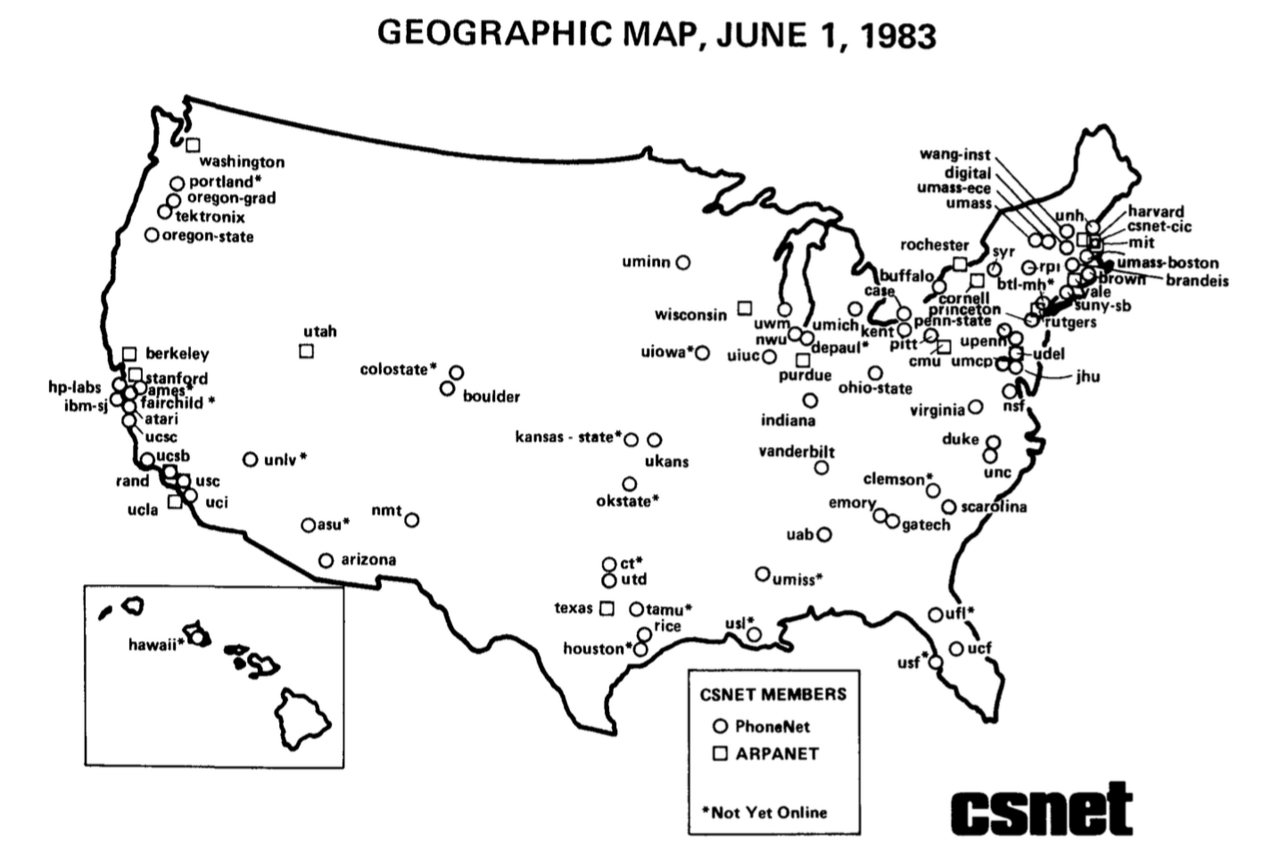
CSNET’s management team was Landweber, David Farber (Delaware), Peter Denning (Purdue), Anthony Hearn (RAND) and Bill Kern of the NSF. It was built in tiers so that a small department could join cheaply: sites with ARPANET contracts used the ARPANET, others connected over Telenet’s public packet network, and the cheapest tier, PhoneNet, exchanged email over ordinary dial-up telephone calls between a member’s computer and a central relay. Gateways tied the tiers together, so a PhoneNet user could write to anyone on the ARPANET.
The first three sites, Delaware, Princeton and Purdue, were connected in 1981; there were 24 in 1982 and 84 by 1984. By then a coordination and information centre at BBN in Cambridge, Massachusetts, open since July 1982 and run by a team under Richard Edmiston, had taken over network operations, and the network went international. Israel joined first; on 3 August 1984 Laura Breeden of the CSNET office sent the University of Karlsruhe its first internet email (see Germany’s IT Industry), and in 1987 the first email from China reached Karlsruhe over a CSNET link (see China’s Tech Industry). Australia, Canada, France, Korea and Japan were also connected. In all CSNET served more than 180 institutions, 60 per cent of them universities.
BITNET
BITNET came from the computing centres rather than the computer science departments. In 1981 Ira Fuchs of the City University of New York and Greydon Freeman of Yale linked their two IBM mainframes using RSCS and NJE, the protocols IBM’s VM and MVS systems already used to pass print and job files between machines. The name stood for “Because It’s There Network”, later “Because It’s Time”. It was a store-and-forward network of leased lines, initially at 9,600 bits per second: messages and files hopped from one mainframe to the next until they arrived. Joining took an IBM mainframe and a leased line to a member already connected.
By April 1988 BITNET connected about 400 universities and 1,200 computers, and by 1991 almost 500 organisations and 3,000 nodes, all of them educational. IBM granted $2 million over three years in the mid-1980s. BITNET’s most lasting product was the mailing list. In 1984 Fuchs, Daniel Oberst and Ricky Hernandez wrote LISTSERV at the BITNET Network Information Center; in 1986 Éric Thomas wrote a new, fully automated version, which made subscribing and unsubscribing a matter of sending a command by email. Thousands of scholarly discussion lists ran on it.
BITNET’s European branch, the European Academic and Research Network (EARN), was connected in 1983 through a transatlantic circuit and gateway paid for by IBM. For most of the 1980s all traffic between the European and American backbones ran over a single 4.8 kbit/s line, later one of 9.6 kbit/s. In Canada the network was NetNorth; there were branches in Israel, India and the Persian Gulf states (see European Computer Science Academia).
NSFNET
In 1985 the NSF chose five supercomputer centres to fund: the John von Neumann Center at Princeton, the Cornell Theory Center, the Pittsburgh Supercomputing Center, the National Center for Supercomputing Applications at the University of Illinois, and the San Diego Supercomputer Center. To let researchers everywhere reach them, it built NSFNET, led at the NSF by Dennis Jennings and later Steve Wolff. Unlike BITNET and CSNET’s dial-up tier, NSFNET used the ARPANET’s TCP/IP protocols. Its first backbone went into operation in 1986 at 56 kbit/s, on PDP-11 “Fuzzball” routers built by David Mills (see David Mills and NTP).
The backbone connected regional networks, which in turn connected campuses: NYSERNet in New York, SURAnet in the south-east, BARRNet in the San Francisco Bay Area, MIDnet, Westnet, NorthWestNet and others, eleven in all, linking about 170 further networks. In November 1987 the NSF signed an agreement with Merit Network, IBM and MCI to run a faster backbone; it reached 13 nodes at 1.5 Mbit/s in July 1988 and 45 Mbit/s in 1991. The ARPANET was switched off in 1990 (see ARPANET: Building the Network).
The End of the Separate Networks
Once campuses had TCP/IP connections through the regionals, BITNET and CSNET lost their reason to exist. They merged into the Corporation for Research and Educational Networking (CREN), in 1989 by Wikipedia’s account (the Computer History Museum says 1987). CSNET was shut down in October 1991. EARN carried its traffic over TCP/IP circuits from December 1989 and merged with the European networking association RARE on 20 October 1994 to form TERENA. CREN ended support for BITNET in 1996, and by 2007 it had essentially stopped. In April 1995 the NSFNET backbone was retired and its traffic handed to commercial carriers (see Early Networking Failures).
CSNET received the Jonathan B. Postel Service Award at the Internet Engineering Task Force meeting of July 2009.
📚 Sources
- Computer History Museum: Internet History, 1970s (THEORYNET, CSNET proposal)
- Computer History Museum: Internet History, 1980s (CSNET, BITNET, NSFNET, supercomputer centres)
- Douglas Comer, “The Computer Science Research Network CSNET”, Communications of the ACM 26:10 (October 1983)
- Peter J. Denning, Anthony Hearn and C. William Kern, “History and Overview of CSNET”, ACM SIGCOMM Computer Communication Review (1983)
- Wikipedia: CSNET
- Wikipedia: BITNET
- Wikipedia: European Academic and Research Network
- Wikipedia: National Science Foundation Network
- Wikipedia: LISTSERV