Lore Harp McGovern and Vector Graphic
Abstract
Lore Harp McGovern (born 1944) arrived in California from West Germany at twenty as a summer guest, sold her return ticket, and in August 1976 started Vector Graphic with her friend Carole Ely in a converted bedroom in Westlake Village, selling a memory board for the Altair that her husband had designed. The company was founded on $6,000, sold a million dollars of boards and computers in its first year, built the Vector 1 in four colours, and went public in October 1981, within a day of Sandra Kurtzig’s ASK; each woman believed she was the first to take a company she had founded public on NASDAQ. Two months earlier IBM had announced its PC. Vector Graphic stayed with CP/M, lost its founder-engineer and then its founder-CEO, filed for bankruptcy in 1985 and was liquidated in 1987.
A Visitor Who Stayed
Lore Harp McGovern was born in 1944 in what is now Poland and grew up in West Germany, in a family that expected university: an aunt born in 1906 had a law degree from Berlin, and her grandfather had been a politician in the Weimar Republic. After her school-leaving exam a friend from her Catholic boarding school passed on an invitation from a family in Santa Cruz, California, and she arrived on 8 February, in 1964 or 1965 (she no longer remembered which). Two months later she hitchhiked to Mexico with a friend, against her hosts’ wishes and her parents’. She kept extending her tourist visa, sold her return ticket when the money ran out, applied for a translation job at SRI that she could not take without a green card, and lived on babysitting.
In Palo Alto she met Bob Harp, a physicist back from a postdoctoral fellowship at the Max Planck plasma physics institute in Garching, and went with him to Pasadena when Caltech made him an assistant professor. A letter from the immigration service caught up with her a year after her visa had lapsed; they told the officials they were engaged, and married in 1968. She took a degree in anthropology at California State University, Los Angeles, had two daughters, and moved with the family to Westlake Village when Bob Harp left Caltech for Hughes Research Laboratories.
A Memory Board in the Bedroom
By 1976 she was restless in the new suburb and planning a business with a neighbour, Carole Ely, whose two children were in the same classes as hers. Their first idea, a travel agency with historians as guides, failed on margins and licensing. Bob Harp, who read the hobby magazines and had built an Altair, had designed an 8K RAM board for it; a former postdoc of his was supposed to manufacture it and had got nowhere in a year, because nobody gave volume prices on 300 chips. Harp McGovern asked if she could try. Then she called Ely: “Carol, how would you like to start a computer company with a memory board?” Ely asked what a memory board was.
The two pooled $10,000. They sold the board as a kit and made it the tidiest kit on the market: silk-screened component positions, plated holes, colour-coordinated capacitors, a red DIP switch. Memory chips were the hard part. An AMD salesman, met at the Westlake Inn because the “office” was a converted bedroom with a stew on the kitchen stove, quoted prices that made the board impossible. Fairchild’s representative knew what an Altair was and agreed to supply on thirty days’ credit; a distributor picked up the chips at Burbank airport and drove them out with doughnuts. Everything was sold cash on delivery to dealers found through BYTE and Interface Age, and at the swap meets in TRW’s space on weekends, so the customers financed the company. Vector Graphic was incorporated on 23 August 1976. On 31 October it sold 81 boards in a day, and Harp McGovern moved the company out of the house into 1,200 square feet of office park.
A PROM board followed so that users of the IMSAI need not toggle a bootstrap in through front-panel switches, then a motherboard and power supply, and in 1977 the Vector 1, a Z80 computer on the S-100 bus, sold in burnt orange, dark green, black or beige. The first year brought a million dollars in sales and broke even. The founders took $4,000 of their $10,000 back out, so Vector Graphic was, in Harp McGovern’s accounting, founded on six thousand dollars. Bob Harp then joined as vice president of research and development, with stock given to him by both women.
The Business Machine
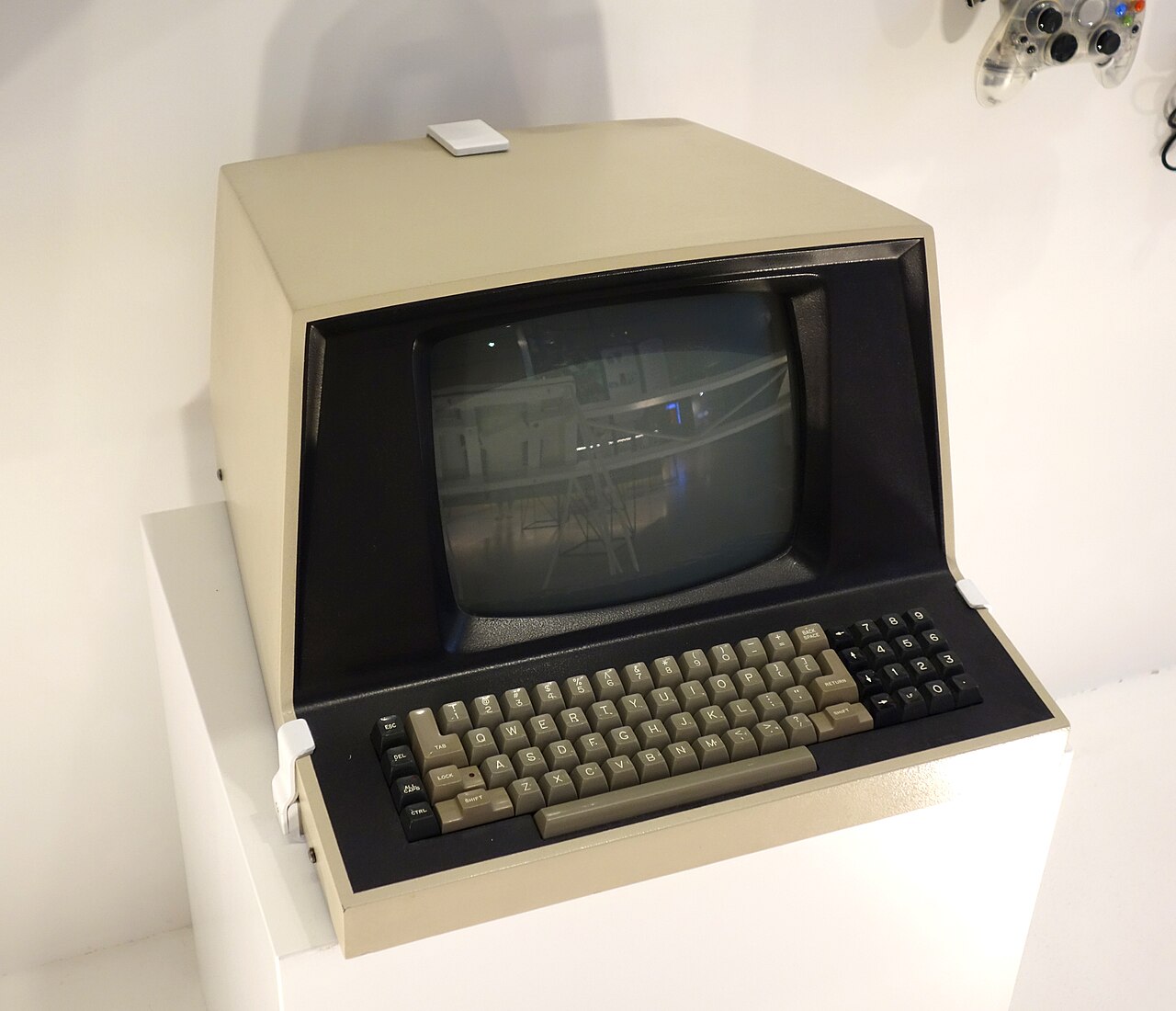
Vector Graphic aimed its machines at small businesses rather than hobbyists. It ran Gary Kildall’s CP/M, wrote its own word processor, Memorite, and spreadsheet, Execuplan, and sold Peachtree accounting with its systems. The Vector 3 put screen, keyboard and computer in one case, and up to five machines could be clustered in an office. Ely ran the dealer network, which reached several hundred dealers in seventeen countries, each required to send staff for training within three months of signing; Harp McGovern, as chief executive, did the OEM deals, among them front ends for Pitney Bowes mailing systems and a contract with Sears. The company offered day care, flexible hours, and a Monday-morning walk through manufacturing followed by a talk to all staff. It raised $750,000 of venture capital, from Sofinnova and Walden, which it did not need; she wanted to know what raising it felt like.
October 1981
IBM’s PC team came to see Vector Graphic before the PC was announced. Harp McGovern remembered Don Estridge sitting in her office with a group of IBM people, and her telling him that a $25-billion company buying from a $25-million one seemed unlikely; they took a Vector 3 away with them. The IBM PC was announced in August 1981. She told her executives the company had a year, if that.
The public offering went ahead, underwritten by Hambrecht & Quist, whose 29-year-old Tom Volpe led it, and Shearson. At the first road-show breakfast in London, an older British investor asked her, a woman in a suit standing about the room, to fetch him a cup of coffee. She did. The underwriter then introduced the chief executive, Lore Harp, and after her presentation she asked the investor whether he would like another cup. He came back afterwards with a second question, how it felt to have so many men working for her. “You don’t hold this one silly chromosome against me, do you?” she asked. Vector Graphic listed on NASDAQ in mid-October 1981; revenue for the year reached $36 million. Every employee received a hundred shares for each year of service, at an option price of one dollar against an offering price close to fourteen. Sandra Kurtzig’s ASK went public the same week; the two women each believed she had been first, by a day or by hours.
The Fall
The marriage ended first. Harp McGovern was on the cover of Inc., and her husband put the thousand copies the magazine sent the company into a dumpster. She had the coming divorce disclosed in the prospectus. Bob Harp left in April 1982, after a dispute over control of the company; he had co-founded Corona Data Systems in 1981, which went on to build some of the first IBM-compatible PCs. Harp McGovern had met Patrick McGovern, the founder of IDG and Computerworld, at a marketing conference in San Francisco in 1981, before the public offering; they married in 1982, two days after her divorce became final.
The strategic error, in her telling, was CP/M. She wanted to add MS-DOS once IBM had chosen it; a board member who had come from IBM argued that IBM would never stay in such a small business, and the board kept CP/M. Bob Harp’s account, given to Fast Company in 2015, puts the positions the other way round; the oral history calls that version wrong. The Vector 4, a hybrid with both a Z80 and an Intel 8088 to run CP/M and MS-DOS, was announced in April 1982, too early: customers stopped buying the Vector 3 to wait for it. Peachtree, which according to Harp McGovern had an exclusive arrangement with Vector Graphic, made its own deal with IBM.
Harp McGovern stepped back to chairman and hired Fred Snow from Honeywell as chief executive. Snow resigned after a family tragedy, and she returned, commuting daily by air from her new home near San Francisco to Burbank for nine months. In 1984, after a falling-out with the board, she left and sold all her shares. Vector Graphic had 425 employees at its peak in 1982 and 36 in the summer of 1985. It filed for Chapter 11 in December 1985 and was liquidated in October 1987.
Afterwards
She invented a disposable urinary funnel for women travellers, sold as Le Funelle by her company Aplex, and took over a bankrupt educational publisher that became Good Morning Teacher!; its unsold workbooks went to schools in China. With Patrick McGovern she founded the McGovern Institute for Brain Research at MIT in 2000, with a gift of about $350 million. Patrick McGovern died in 2014. In her 2016 oral history, recorded in the Hillsborough house from which she had once commuted to Burbank, she said that even then, the number of women in real top positions was “still not very, very big.”
📚 Sources
- Oral History of Lore Harp McGovern, Computer History Museum, 3 November 2016, Hillsborough, CA, interviewed by Gardner Hendrie · transcript PDF (family, the arrival on 8 February 1964/65, Mexico, the sold return ticket and SRI, Bob Harp and Garching, Caltech and the immigration letter, Cal State LA anthropology, Westlake Village and Hughes, the travel agency, the 8K board and the call to Carole Ely, $10,000 pooled, the kit design, AMD and Fairchild, COD and the TRW swap meets, incorporation on 23 August 1976, 81 boards on 31 October, the 1702 PROM board, Vector 1 colours, $1 million and the $6,000, Bob Harp as VP R&D, CP/M, Memorite and Execuplan, clustering, the dealer network in seventeen countries, Pitney Bowes and Sears, employee benefits, the $750,000 from Sofinnova and Walden, Estridge’s visit and the Vector 3, H&Q, Volpe and Shearson, the London breakfast, shares for every employee, the NASDAQ dispute with Kurtzig, the Inc. cover and the dumpster, the divorce in the prospectus, meeting Pat McGovern before the IPO and marrying him two days after the divorce, the DOS decision, Fred Snow, the Burbank commute, leaving and selling her stock, Le Funelle, the educational publisher, the McGovern Institute in 2000)
- Math Whizzes and Computing Pros, Computer History Museum (founding in 1976 in her bedroom, the Altair memory board, Vector 1 in 1977, the October 1981 IPO alongside Kurtzig, the Business Week and Inc. covers)
- Lore Harp McGovern — Wikipedia (born 3 March 1944 in German-occupied Poland; married Bob Harp in 1968 and divorced 1982; married Patrick McGovern in 1982; revenue of $36.2 million in 1981; left in 1984; Aplex and Good Morning Teacher!; McGovern Institute with about $350 million in 2000)
- Vector Graphic — Wikipedia (founded 1976 by Carole Ely and Lore Harp; Vector 1 with a Z80 in 1977; the Vector 3 and the Vector 4 hybrid; 425 employees in 1982; the Vector 4 pre-announcement and Robert Harp’s departure in April 1982; Chapter 11 in December 1985 and Chapter 7 liquidation in October 1987; 36 employees in summer 1985)
- Corona Data Systems — Wikipedia (founded in mid-1981 by Robert Harp; the Corona PC in 1983)
- Benj Edwards, “How Two Bored 1970s Housewives Helped Create The PC Industry”, Fast Company, July 2015 (Bob Harp’s account of the DOS question)
- Dave Farquhar, “Women in tech: The forgotten story of Vector Graphic”, The Silicon Underground (summary of the Fast Company article: the Vector 4 announcement killing Vector 3 sales, bankruptcy in 1985, liquidation in October 1987)