Will Wright
Abstract
Will Wright (born 1960) designed computer games without a way to win. SimCity (1989) handed the player a city simulation with no goal, a design every major publisher first turned down; it sold a million copies by 1992 and gave the industry the word “sandbox”. With Jeff Braun he founded Maxis, which Electronic Arts bought in 1997. His next idea, a simulated household, was dismissed in a focus group as a dollhouse; released as The Sims in 2000, it overtook Myst as the best-selling PC game, and most of its players were women. His last big project for EA, Spore (2008), sold well and disappointed critics.
The Island Editor
Wright was born in Atlanta on 20 January 1960 and grew up building model ships, cars and planes. His father, a materials engineer, died of leukaemia when Wright was nine. He studied architecture at Louisiana State University, then mechanical engineering at Louisiana Tech, then spent a year at The New School in New York, and left without a degree. In 1980 he and the race organiser Rick Doherty won the U.S. Express, an illegal coast-to-coast car race, driving a Mazda RX-7 from Brooklyn to Santa Monica in 33 hours and 39 minutes. In New York he bought an Apple II+ and taught himself BASIC, Pascal and assembly language.
His first game, Raid on Bungeling Bay, a helicopter shooter, came out from Brøderbund in 1984 for the Commodore 64. It sold about 30,000 copies there; Hudson Soft’s version for the Nintendo Famicom and NES sold about 750,000 in Japan and the United States, and the royalties gave Wright a steady income for his next project. To build the game’s islands Wright had written an editor, and he found he enjoyed placing roads and buildings more than bombing them.
SimCity
From 1985 Wright turned the editor into a city that ran by itself. A neighbour, the architect Bruce Joffe, had studied under Jay Forrester and pointed him to Forrester’s Urban Dynamics (1969), which modelled a city as stocks, flows and feedback loops (see The Limits to Growth and World3). Wright also borrowed from Stanisław Lem’s story “The Seventh Sally”, in which an engineer builds a deposed tyrant a miniature kingdom in a box. The working title was Micropolis.
Brøderbund signed the project and then kept asking when he would turn the simulation into a game, with a winning state. Wright answered that the simulation was the game, like a dollhouse or a model railway. The other publishers he approached turned it down for lacking any arcade action. At a pizza party in 1986 he met Jeff Braun, a young entrepreneur, who later remembered: “Will is a very shy guy, and he was sitting by himself, and I felt sorry for him.” Wright told him nobody liked the program. Braun did, and in 1987 the two founded Maxis to finish it for the Macintosh and Amiga. When Brøderbund saw the nearly finished version in 1988, it took on distribution.
SimCity shipped for the Macintosh in February 1989, followed by Commodore 64, Amiga and DOS versions that year. It started slowly: by mid-June 1989 Maxis had sold 11,000 Macintosh and 8,000 Amiga copies. Press coverage changed that; Time magazine wrote its first review of a computer game about it, and by late 1992 it had sold a million copies, half on home computers and half on the Super Nintendo. Universities used it in planning courses. In 1990 the Providence Journal had five mayoral candidates run a SimCity town; the best of them, former mayor Buddy Cianci, also won the real election that year. Wright’s own account of play testing was that people bulldozed buildings for ten minutes, “laughing their heads off”, and then discovered that destruction was easy and creation was the hard part.
Maxis followed with SimEarth (1990), SimAnt (1991) and SimCity 2000 (1993), went public in 1995, and was bought by Electronic Arts in a stock swap worth about $125 million, announced on 4 June 1997 and completed in July. In January 2008 the original SimCity code was released under the GPL as Micropolis for the One Laptop per Child project (see Nicholas Negroponte).
The Sims
In October 1991 Wright’s house burned down in the Oakland hills firestorm. Replacing everything he owned started him thinking about a game in which people furnish a home and run their daily lives. A focus group disliked the idea, and Maxis’s management saw little market for a digital dollhouse. Wright developed it on the side as “Project X” while the company worked on SimCity 2000 and SimCopter, with Jamie Doornbos as lead programmer. At the E3 trade show in 1999 two female characters at an in-game wedding fell in love and kissed in front of the audience; the team then let each character’s orientation follow the player’s choices.
The Sims came out for Windows on 4 February 2000. It was the best-selling computer game in the United States in 2000 (1.77 million copies) and again in 2001, and by 2002 it had passed Myst as the best-selling PC game, with more than 6.3 million copies. Women made up almost 60 per cent of its players by a 2008 count; the Computer History Museum puts their share at more than sixty per cent. His explanation was blunter than any marketing study: “People inherently are narcissistic. Anything that’s about them is going to be 10 times more fascinating than anything else.” With its expansion packs the game had sold more than 41 million units by September 2004, and it became a franchise that EA still publishes (see The Video Game Industry).
Spore
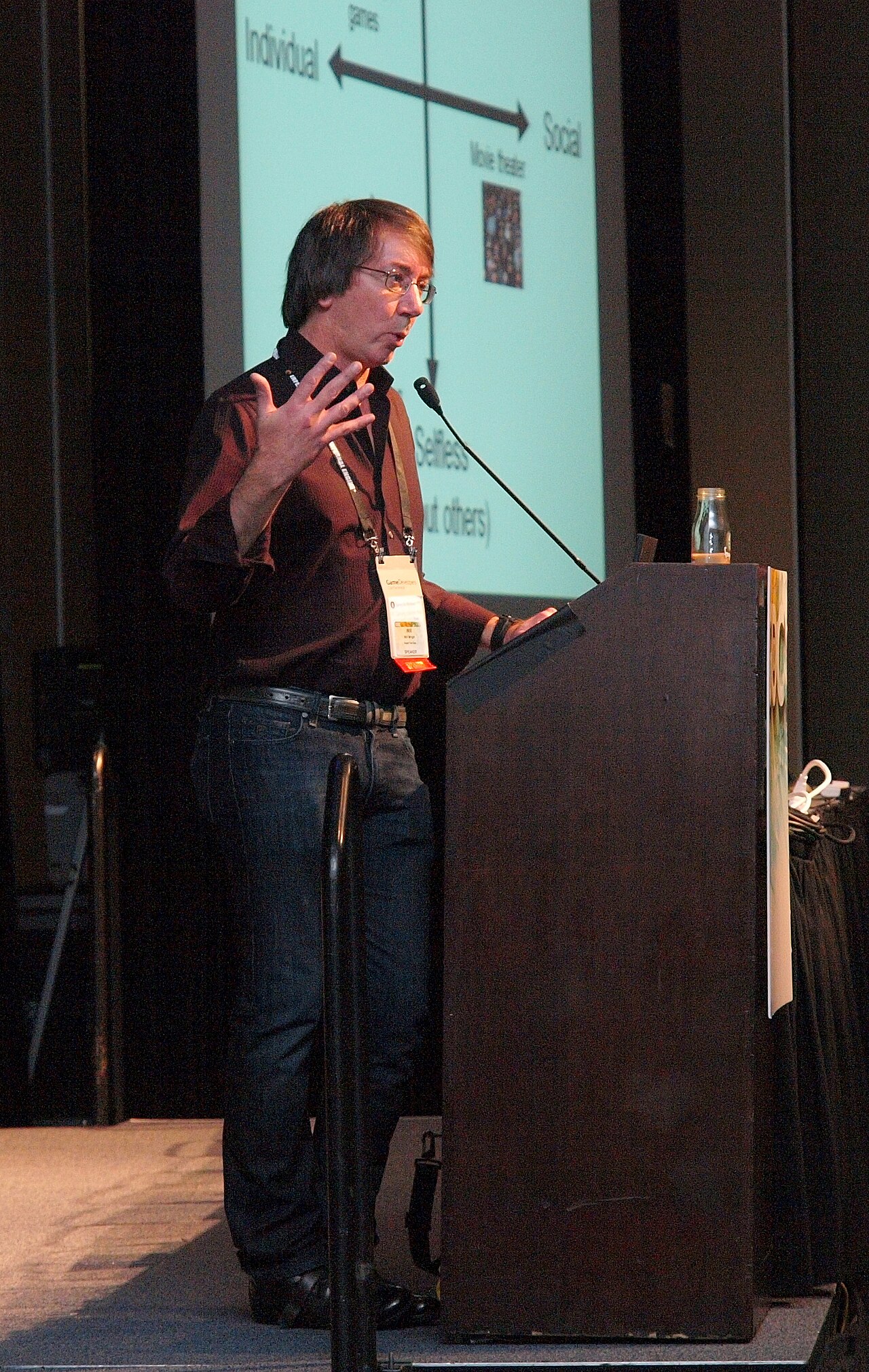
Wright showed Spore at the Game Developers Conference in March 2005: a single game that would take a species from a cell to a space-faring civilisation. It came out in September 2008 and sold about two million copies in three weeks. Critics found the individual stages simple; GameSpot wrote that “individual gameplay elements are extremely simple”. A panel assembled by Science graded its biology and gave Fs for mutation, natural selection and genetics. EA’s copy protection, SecuROM, limited each copy to three installations, and by 14 September 2008, 2,016 of the 2,216 Amazon ratings for the game were one star, most of them protests against the DRM.
Wright left EA in April 2009 to run Stupid Fun Club, a think tank for games, toys and television that produced the TV series Bar Karma (2011). In 2001 he received the Game Developers Conference’s lifetime achievement award, and in 2007 he was the first game designer made a BAFTA Fellow. The Strong National Museum of Play in Rochester holds nine of his graph-paper notebooks with sketches and code for SimCity 2000, SimCopter, The Sims and Spore.
📚 Sources
- Wikipedia: Will Wright (game designer)
- Wikipedia: SimCity (1989 video game)
- Wikipedia: The Sims (video game)
- Wikipedia: Spore (2008 video game)
- Jimmy Maher, “SimCity, Part 1: Will Wright’s City in a Box”, The Digital Antiquarian (June 2016)
- Jimmy Maher, The Digital Antiquarian, articles tagged SimCity (Time’s first computer-game review)
- John Bohannon, “Flunking Spore”, Science 322 (24 October 2008)
- Computer History Museum: Timeline of Computer History, 2000 (The Sims)
- Tristan Donovan, “The Replay Interviews: Will Wright”, Game Developer (23 May 2011)
- Jon-Paul Dyson, “Will Wright’s Video Game Notebooks”, The Strong National Museum of Play (21 January 2011)
- Electronic Arts Inc., Form 8-K on the Maxis merger (1997), SEC EDGAR
- Image: Will Wright - Game Developers Conference 2010.jpg by Official GDC (CC BY 2.0), via Wikimedia Commons