The Linux Distributions: From Floppy Sets to Enterprise Subscriptions
Abstract
A kernel is not an operating system. In the autumn of 1991 anyone who wanted to run Linus Torvalds’ new kernel had to find a compiler, a shell, a C library and a few hundred utilities, mostly from the GNU Project, and assemble them by hand. The Linux distribution packaged all of it into something that installed from a stack of floppy disks. The first ones appeared in early 1992. In 1993 three lines started that still exist: Slackware, a cleanup of a buggy predecessor; Debian, a volunteer project with a written constitution; and the companies that became Red Hat and SUSE. Red Hat’s stock gained about 270 percent on its first trading day in August 1999, and IBM bought the company for $34 billion in 2019. Ubuntu (2004) brought free CDs by post and a six-month release rhythm. Hundreds of distributions followed, most of them derived from Debian, Red Hat or Arch. The attempts to sell Linux to ordinary PC buyers, from Corel Linux to Lindows, failed; the distributions won on servers, in the cloud and inside other products instead.
Boot Disks and Root Disks
The first way to try Linux was a pair of floppy images that Torvalds himself put out. Version 0.10 of his “boot” and “root” disks is dated 4 November 1991: one disk held the kernel, the other a minimal file system with a shell. Everything else had to be compiled and copied over by the user. H. J. Lu published his own bootable root disks in September 1992.
The first collection meant for people who were not Unix experts came from Owen Le Blanc at the Manchester Computing Centre of the University of Manchester, which had offered Linux by anonymous FTP since November 1991. MCC Interim Linux, first released in early 1992 and based on kernel 0.12, had a menu-driven installer that put the kernel and a set of tools on the hard disk: bash, GNU utilities, grep, sed, tar, the editors elvis and joe, and, on an optional extra pair of disks, the gcc compiler. Texas A&M University followed with TAMU Linux in July 1992, which added the X Window System.
Peter MacDonald’s Softlanding Linux System (SLS), first released in May 1992, was the first distribution that tried to be complete: kernel, GNU userland, X11 and networking, on a numbered set of floppies. It was widely used and had a reputation among its users for bugs. Two of the people who were annoyed by it started distributions of their own.
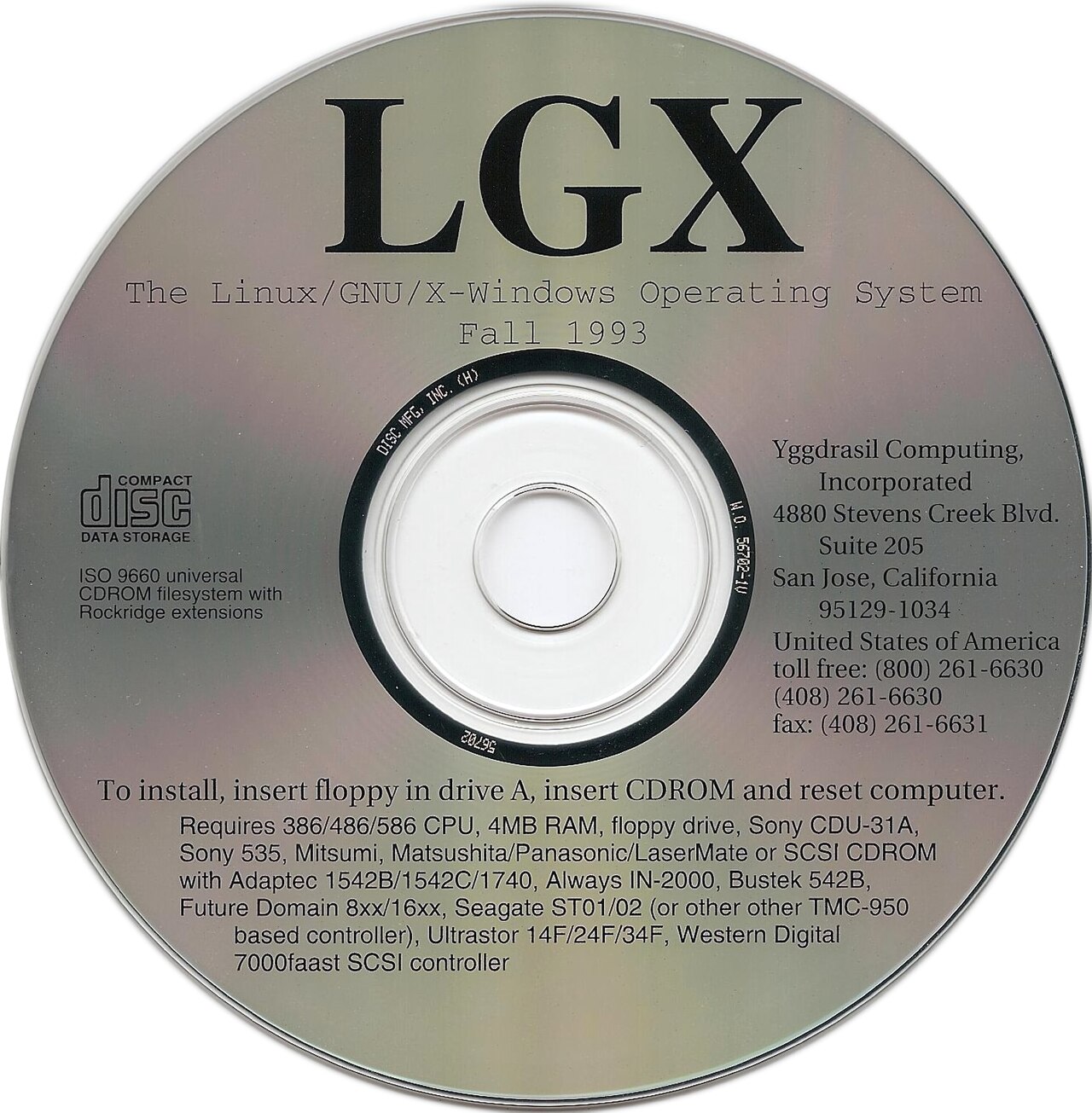
The first commercial distribution on CD-ROM came from Berkeley. Adam J. Richter and Bill Selmeier of Yggdrasil Computing announced Yggdrasil Linux/GNU/X on 25 November 1992 and shipped an alpha version on 8 December. The beta of February 1993 cost $60, the production release $99. It booted and ran directly from the disc, which makes it the first live CD, and it advertised itself as “Plug-and-Play”, configuring itself for the hardware it found. Its motto was “Free Software For The Rest of Us.” Yggdrasil released a Linux DVD as late as 2000; its last corporate filing was in January 2004.
Slackware
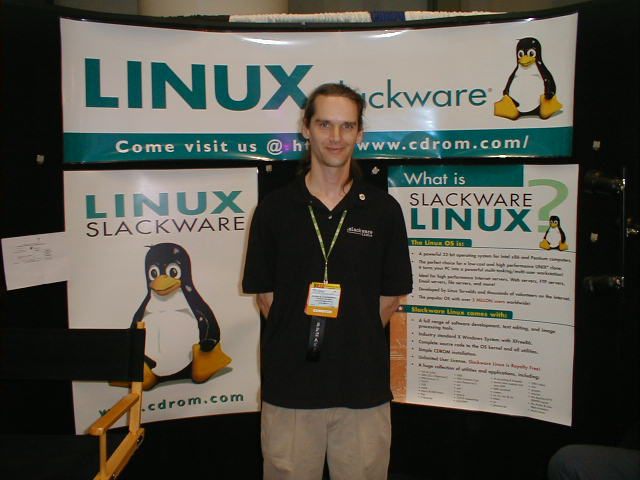
Patrick Volkerding, a student at Moorhead State University in Minnesota, installed SLS because he needed a LISP interpreter for a course project. A professor asked him to show how to install Linux for graduate students doing LISP work, and Volkerding fixed the bugs he ran into on the way until his version had drifted away from SLS. Friends at the university urged him to publish it, and with the local system administrator’s approval he put it on an anonymous FTP server. Because SLS’s installation scripts were not licensed for redistribution, he wrote his own. He named it Slackware so that nobody would take the side project too seriously; the word is a nod to the “Slack” that the parody religion Church of the SubGenius preaches. Slackware 1.00 appeared on 17 July 1993 as twenty-four 3.5-inch floppy disk images.
Slackware stayed close to its origins. Its package tools install and remove tarballs and do not track dependencies, so users who add third-party software have to find the missing libraries themselves. Configuration happens in text files rather than in graphical tools. Volkerding has remained the project’s maintainer and final decision-maker for more than thirty years. Releases arrive when he considers them ready: version 14.2 came in June 2016, and 15.0 only on 2 February 2022, more than five years later. Slackware is the oldest Linux distribution that is still maintained, and SUSE began as a German translation of it.
Debian
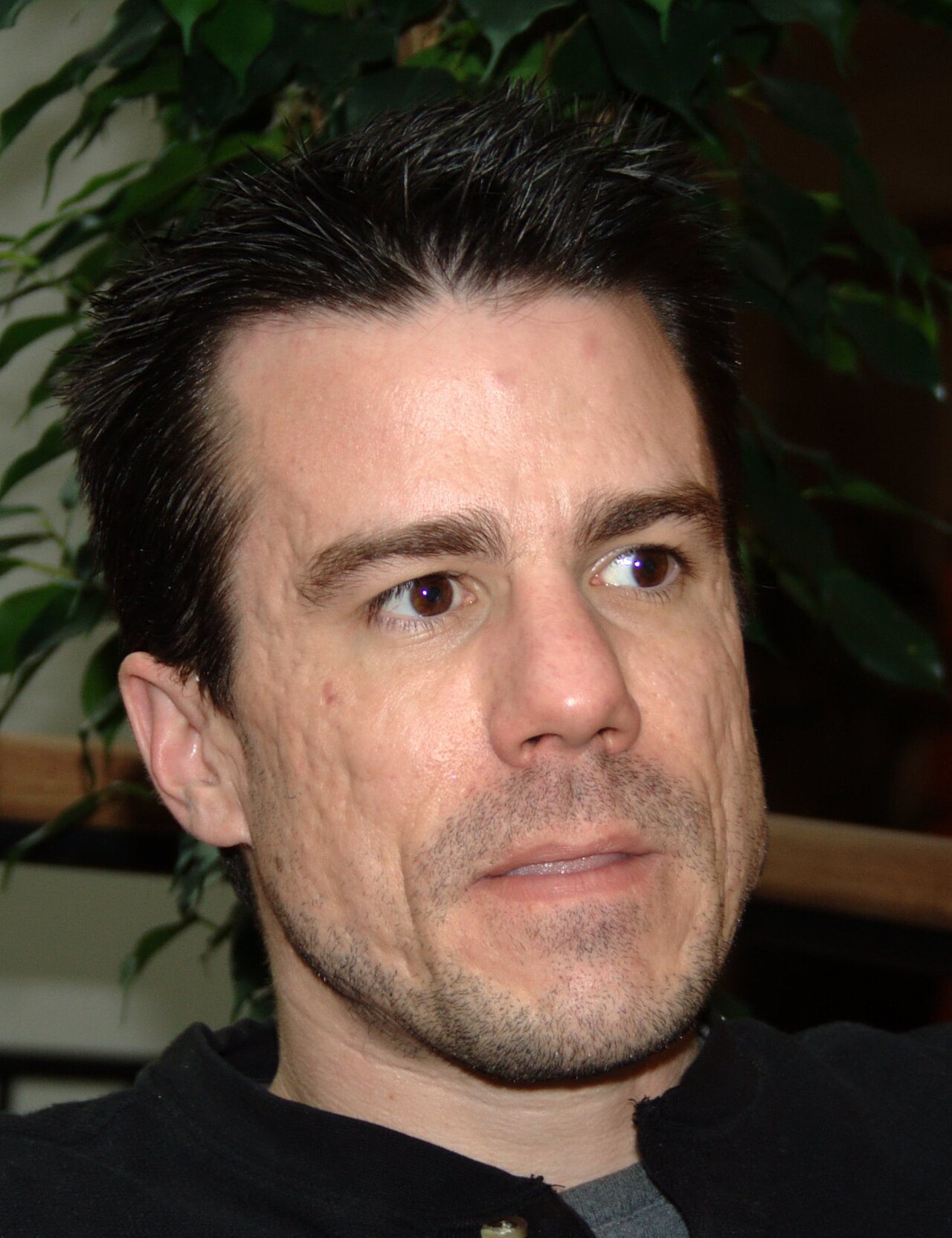
Ian Murdock, an undergraduate at Purdue University, was the other SLS user who gave up on it. On 16 August 1993 he announced on the newsgroup comp.os.linux.development that he was starting a new distribution. He named it Debian, after his then-girlfriend (later wife) Debra Lynn and himself. The first public betas of January 1994 carried his Debian Manifesto, which said the system was “being developed openly in the spirit of Linux and GNU.” It accused commercial distributors of shipping badly maintained software for profit and argued that a non-commercial group could look after quality “without the pressure of profits or returns.”
The Free Software Foundation paid for Debian’s development from November 1994 to November 1995 and then withdrew over disagreements about technical direction. Bruce Perens, then working at Pixar, became project leader in April 1996. Debian 1.1, released on 17 June 1996, was the first release named after a character from Toy Story (“Buzz”); every release since has carried such a name, and the permanently unstable development branch is called “Sid”, after the neighbour’s boy who breaks toys.
Perens drafted the two documents that defined the project. The Debian Social Contract and the Debian Free Software Guidelines (DFSG) were published on 4 July 1997 after discussion and a vote among the developers. The contract promises that Debian will remain entirely free software, give its work back to the free-software community and not hide problems from its users. The DFSG set out which licences count as free. When Perens and Eric Raymond founded the Open Source Initiative in February 1998, the Open Source Definition was the DFSG with the Debian-specific references removed. A formal Debian Constitution, with an elected project leader, a technical committee and general resolutions voted on by all developers, followed on 2 December 1998.
Debian’s lasting technical contribution is its package management. The .deb format records each package’s dependencies, and APT, which arrived with Debian 2.1 “Slink” on 9 March 1999, resolves them automatically: apt-get install downloads a program together with everything it needs. Other distributions adopted the same approach. The project grew from 347 developers in 1999 to more than 900 for Debian 3.0 in 2002, when the release carried about 8,500 binary packages; current releases carry tens of thousands. Many distributions are built on Debian, Ubuntu among them.
Governance by vote has its costs. In February 2014 Debian’s technical committee chose systemd, Lennart Poettering’s new init system and service manager, as the default, after one of the longest debates in the project’s history; several members resigned in the aftermath. Debian 8 “Jessie” shipped with it in April 2015. Opponents announced a systemd-free fork, Devuan, in November 2014, which published its first stable release on 25 May 2017. Ian Murdock died in San Francisco on 28 December 2015, aged 42.
Red Hat
Red Hat grew out of two small businesses. In March 1993 Bob Young incorporated the ACC Corporation, a mail-order company in Connecticut that sold Linux and Unix books, CDs and accessories. Marc Ewing, a programmer in North Carolina, was putting together his own distribution. As a student working in the computer lab at Carnegie Mellon he had worn his grandfather’s red Cornell lacrosse cap, and people looking for help were told to find the guy in the red hat; he named the distribution after it. He sold a beta, version 0.9, from 31 October 1994, known as the “Halloween” release; version 1, the “Mother’s Day” release, followed in May 1995. In 1995 Young bought Ewing’s business and the two merged it into Red Hat Software, with Young as chief executive.
Red Hat’s technical contribution was the RPM Package Manager (originally “Red Hat Package Manager”), which became the second major package format beside Debian’s. Its business contribution was to sell boxed Linux in computer shops and then to sell what came after the box: support, certification and updates. On 11 August 1999 Red Hat went public. The shares were priced at $14 and closed the first day at $52.06, a gain of about 272 percent. Red Hat had reserved part of the offering for open-source developers who had contributed to its products, but the shares were sold through E*Trade, whose questions on investment experience and finances shut out, by one participant’s estimate, more than half of the invited programmers.
In March 2002 Red Hat introduced Red Hat Linux Advanced Server, soon renamed Red Hat Enterprise Linux (RHEL): a version with a long support cycle, sold only by subscription. The free, boxed Red Hat Linux ended with version 9 in 2003 and reached end of life on 30 April 2004. Its development continued as the community-run Fedora project, which merged with Red Hat’s own development work on 22 September 2003 and serves as RHEL’s testing ground. The model is described in The Open Source Business Model. IBM announced on 28 October 2018 that it would buy Red Hat for $34 billion and closed the deal on 9 July 2019.
SUSE
Germany had its own Linux company before the United States had one. On 2 September 1992 three mathematics students and a recently graduated software engineer, Roland Dyroff, Thomas Fehr, Hubert Mantel and Burchard Steinbild, founded the Gesellschaft für Software- und System-Entwicklung (S.u.S.E.) in Fürth, near Nuremberg. They first sold SLS and then a German translation of Slackware on about 40 floppy disks. S.u.S.E. then built a distribution of its own on Florian La Roche’s Jurix, and from May 1996 it shipped YaST, a menu-driven installation and configuration tool that became the distribution’s trademark. SUSE Linux Enterprise Server 7 followed in August 2001.
The company’s ownership history is a list of the industry’s mergers. Novell announced on 4 November 2003 that it would buy SuSE Linux AG for $210 million and launched the community project openSUSE on 4 August 2005. The Attachmate Group bought Novell in 2011, Attachmate merged with Micro Focus in 2014, and in 2018 Micro Focus sold SUSE to the Swedish investment firm EQT for $2.535 billion. SUSE went public on the Frankfurt Stock Exchange on 19 May 2021 at €30 a share; on 13 November 2023 its shareholders voted to take it off the exchange again.
Caldera, Mandrake and the Boom of 1999
The late 1990s produced a crowd of commercial distributions. Caldera, founded in 1994 by Bryan Sparks and Ransom Love with money from former Novell chief Ray Noorda’s Canopy Group, aimed at businesses. Its OpenLinux merged in 1997 with the work of the German company LST and in 1999 gained Lizard, one of the first graphical installers. In 2000 Caldera began buying the Unix business of the Santa Cruz Operation, and in August 2002 it renamed itself The SCO Group. The following year that company sued IBM over Linux, a story told in Commercial Unix and the Unix Wars.
Mandrake Linux, first released on 23 July 1998 by Gaël Duval in Paris, was Red Hat Linux 5.1 with the KDE desktop installed and configured, at a time when Red Hat did not ship KDE because of licence doubts about its Qt toolkit. It became the distribution recommended to beginners. The publisher Hearst, owner of the comic character Mandrake the Magician, won a trademark case against MandrakeSoft in 2004; in April 2005 the company bought the Brazilian distribution Conectiva and took the name Mandriva. Its last release appeared in 2011. Laid-off developers carried on as Mageia, and the remaining staff formed OpenMandriva.
In May 2002 Caldera, SuSE, Turbolinux and Conectiva announced UnitedLinux, a common base for enterprise distributions mostly built on SuSE’s code. It was meant to give the smaller companies a counterweight to Red Hat and lost its purpose a year later, when Caldera, now SCO, turned on Linux.
Live CDs and Enthusiast Distributions
In September 2000 the German consultant Klaus Knopper released Knoppix, a Debian-based system that booted from CD, detected the hardware and ran without touching the hard disk. Yggdrasil had done the same eight years earlier; Knoppix arrived when CD drives and RAM were cheap enough to make it practical. It was used for demonstrations, data rescue and as a first look at Linux, and installers that run from a live session are now the normal way to install most distributions.
Other projects went the opposite way and gave the user more work. Daniel Robbins started Enoch Linux in 1999 and renamed it Gentoo, after the fastest-swimming penguin; Gentoo 1.0 appeared on 31 March 2002. Its Portage system, modelled on the FreeBSD ports collection, compiles every package from source with options chosen by the user. Judd Vinet released Arch Linux on 11 March 2002, inspired by the minimalist Canadian distribution CRUX. Arch is a rolling release, with no version numbers, only a continuous stream of updates through its package manager pacman, and its community wiki became one of the most used Linux references regardless of distribution. Valve based SteamOS 3, the system of its Steam Deck handheld (2022), on Arch, and in September 2024 began paying for work on Arch’s build infrastructure (see Valve and Steam).
The website DistroWatch, started by Ladislav Bodnar on 31 May 2001, has catalogued the field since: several hundred active distributions, ranked by how often their pages are viewed, which DistroWatch itself warns says nothing about how many people use them.
Ubuntu
Mark Shuttleworth, a South African who had been a Debian developer in the 1990s, sold his certificate authority Thawte to VeriSign in December 1999 for $575 million and in April 2002 paid a reported $20 million to fly to the International Space Station on a Russian Soyuz. In April 2004 he invited about a dozen Debian developers to his flat in London and proposed a Debian-based distribution with a fixed release schedule, a single default desktop and paid developers. He founded the company Canonical to employ them. The name Ubuntu comes from the Nguni word for “humanity to others.”
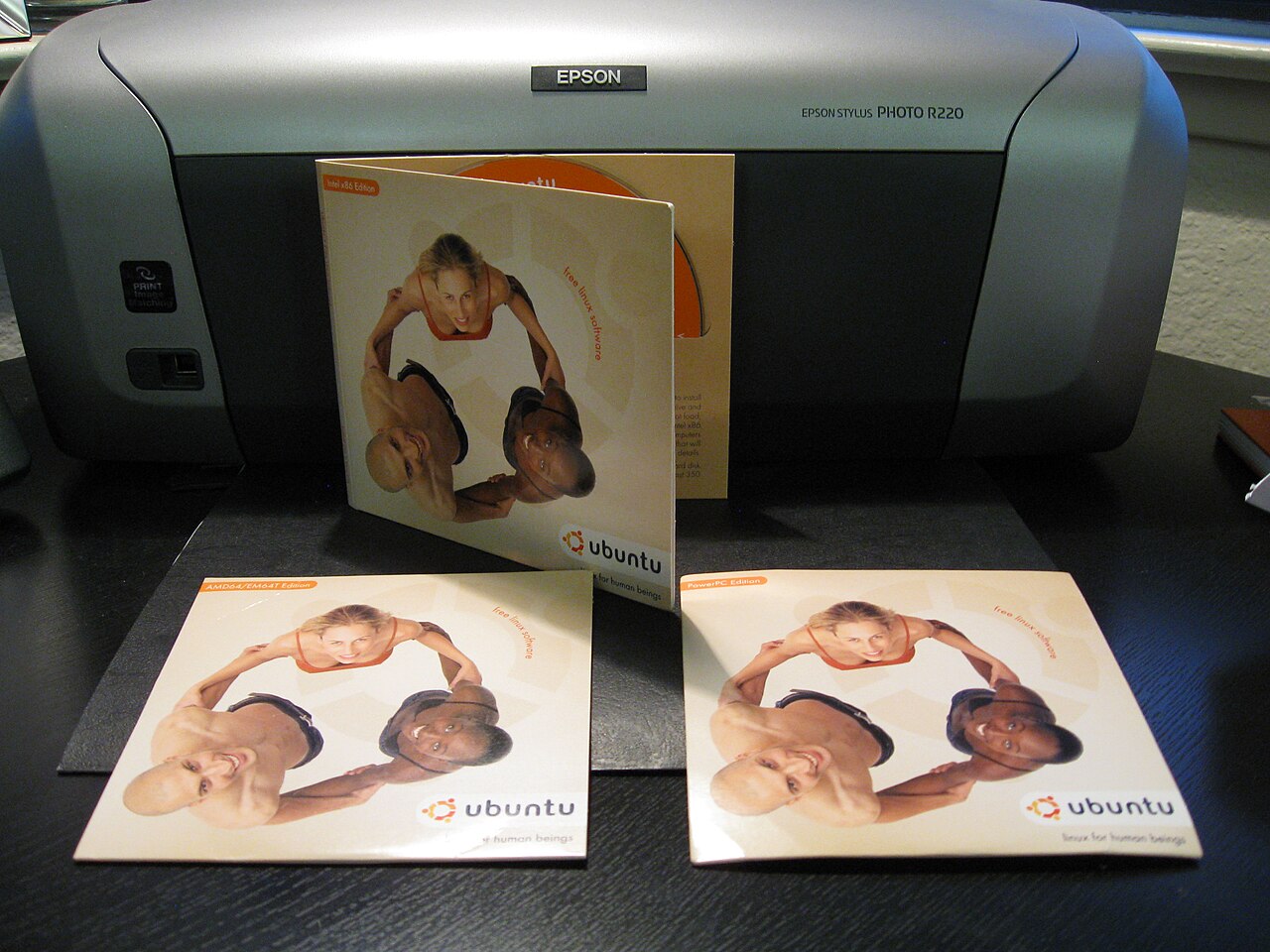
Ubuntu 4.10 “Warty Warthog” was released on 20 October 2004. A new version followed every April and October; every fourth release, in even-numbered years, became a long-term support release with five years of updates, later extended. Through its ShipIt service Canonical posted pressed CDs free of charge to anyone who asked, in every country, until broadband made the service unnecessary and it ended in April 2011. Canonical’s attempts to control its own stack were less successful. In 2011 it replaced the GNOME desktop with its own Unity shell, and from 2012 the Unity search sent queries to Amazon and showed shopping results, which drew a complaint to the UK Information Commissioner. On 5 April 2017 Shuttleworth announced that Canonical would stop investing in Unity 8 and in its plan for a single interface across phone and desktop; Ubuntu 17.10 returned to GNOME. Linux Mint, started by Clément Lefèbvre in August 2006 and based on Ubuntu from its second release, gained users from people who disliked Unity, and in 2012 it introduced Cinnamon, a desktop that kept the traditional layout. On 20 February 2016 attackers broke into the Mint website and briefly replaced a download link with an installer image containing a backdoor.
The Enterprise Clones
Because RHEL’s source code had to be published under the GPL, others could rebuild it without the trademarks and give it away. CentOS, which grew out of Gregory Kurtzer’s cAos project, released its first version on 14 May 2004, rebuilt from RHEL 2.1. For fifteen years it was the free way to run a system compatible with RHEL, used by web hosts, universities and companies that did not want support contracts. In January 2014 Red Hat took over the project and its trademark.
On 8 December 2020 the project announced that CentOS Linux 8 would end in December 2021, eight years before the end of support its users had been promised for 2029, and that the effort would move to CentOS Stream, a rolling preview of the next RHEL release rather than a copy of the current one. The reaction was overwhelmingly negative. Kurtzer announced a replacement, Rocky Linux, within days; the hosting company CloudLinux announced AlmaLinux on 10 December 2020 and released it on 30 March 2021. On 21 June 2023 Red Hat stopped publishing RHEL’s sources on git.centos.org, leaving CentOS Stream as the only public source and RHEL’s own sources available to customers. AlmaLinux then gave up exact one-to-one compatibility and aims for binary compatibility instead.
⚠️ Dead End: Linux for the Living Room
Every few years a company tried to sell Linux to the ordinary PC buyer, and none succeeded.
Corel, the Canadian maker of CorelDRAW and owner of WordPerfect, released Corel Linux on 15 November 1999: a Debian-based system with a simplified KDE desktop, a graphical installer and its own file manager, meant to carry WordPerfect Office onto Linux. The office suite ran through Corel’s own version of the Windows-compatibility layer Wine and was slow. Corel ended its Linux business in August 2001 and sold the code and the team to Xandros, whose Debian-based desktop survived until the end of the decade, mostly on the early Asus Eee PC netbooks.
Michael Robertson, founder of MP3.com, incorporated Lindows in San Diego in July 2001. It promised a Linux that would run Windows programs and sold software through a one-click store called Click-N-Run, for a subscription. Microsoft sued over the name; in March 2002 a federal judge in Seattle refused a preliminary injunction and questioned whether “Windows” was a valid trademark at all, since the word was generic. In 2004 Microsoft paid an estimated $20 million for the trademark, and Lindows became Linspire. The company moved its system onto an Ubuntu base in 2007, sold its assets to Xandros in 2008, and Linspire was discontinued.
Canonical made the most ambitious attempt. On 22 July 2013 it asked for $32 million on Indiegogo to build the Ubuntu Edge, a phone that would turn into a desktop PC when connected to a monitor. The campaign raised about $12.8 million, at the time a crowdfunding record, and failed; the phone was never built, and after Canonical dropped its phone work in 2017 the platform passed to the volunteer UBports community.
The reasons are covered in the Dead End of Linus Torvalds and Linux: pre-installed Windows, missing commercial applications and drivers that came late. The Linux that ordinary users did adopt came from elsewhere, as the kernel inside Android and ChromeOS, where users never see a distribution at all. The phone attempts before Ubuntu are told in Dead End: Maemo and MeeGo, and the desktops themselves in The History of Desktop Environments.
📚 Sources
- Linux distribution, Wikipedia (Torvalds’ boot/root images 4 November 1991, H. J. Lu, MCC, TAMU, SLS, Yggdrasil dates)
- MCC Interim Linux, Wikipedia (Owen Le Blanc, FTP since November 1991, kernel 0.12, contents of the disks)
- Softlanding Linux System, Wikipedia (Peter MacDonald, May 1992, reputation for bugs, origin of Slackware and Debian)
- Yggdrasil Linux/GNU/X, Wikipedia (Richter and Selmeier, announcement and release dates, prices, first live CD, motto, last filing)
- Slackware, Wikipedia (LISP origin, name, 17 July 1993, 24 floppies, no dependency tracking, 14.2 and 15.0, oldest maintained distribution)
- Linux Journal, “Interview with Patrick Volkerding” (Moorhead State, CLISP, the professor’s request, friends at MSU, FTP server) and Linux.com, “Stories of Linux: A Look at Slackware Linux” (SLS install scripts not redistributable)
- Debian, Wikipedia (announcement 16 August 1993, name, manifesto, FSF sponsorship, Perens, Buzz, Social Contract, constitution, APT, systemd decision, developer and package counts, Murdock’s death)
- Murdock, Ian: “The Debian Linux Manifesto” (1994) and Debian Social Contract
- Open Source Initiative: History of the OSI (founding February 1998, Open Source Definition derived from the DFSG)
- Devuan, Wikipedia (fork in November 2014, first stable release 25 May 2017)
- Red Hat, Wikipedia (ACC Corporation, Ewing, the 1995 merger, IPO, Advanced Server 2002, IBM acquisition dates)
- Red Hat Linux, Wikipedia (Halloween beta 31 October 1994, Mother’s Day release, RPM, Red Hat Linux 9, end of life 30 April 2004, Fedora merger 22 September 2003)
- Red Hat blog, “Open Brand Project: the helpful guy in the red hat” (Ewing, Carnegie Mellon lab, grandfather’s Cornell lacrosse cap)
- Salon, “A Linux lament” (30 July 1999) (directed share program for developers, E*Trade eligibility)
- Salon, “Red Hat’s IPO” (12 August 1999) ($14 offering price, close at $52.06) and Encyclopedia.com, “Red Hat, Inc.” (which gives the gain as “227 percent”, a transposition of the 272 percent that the two prices imply)
- SUSE S.A., Wikipedia (founding 2 September 1992, founders, Slackware translation, Jurix, YaST, Novell, openSUSE, Attachmate, Micro Focus, EQT, IPO and delisting)
- SUSE, “SUSE Celebrates 20th Anniversary in 2012” (three mathematics students and a software engineer)
- Caldera OpenLinux, Wikipedia (founders, Canopy, LST, Lizard, rename to SCO Group, UnitedLinux)
- Mandriva Linux, Wikipedia (first release 23 July 1998, Red Hat 5.1 and KDE, Hearst case, Conectiva, last release 2011, Mageia and OpenMandriva)
- Linux Today, “Health Check: Mandriva” (Red Hat’s reservations about Qt, KDE missing from Red Hat)
- Knoppix, Wikipedia (Klaus Knopper, first release 30 September 2000)
- Gentoo Linux, Wikipedia (Enoch, 1.0 on 31 March 2002, Portage and BSD ports, name)
- Arch Linux, Wikipedia (Judd Vinet, 11 March 2002, CRUX, pacman, rolling release, SteamOS 3, Valve sponsorship September 2024)
- DistroWatch, Wikipedia (31 May 2001, ranking caveat)
- YaST, Wikipedia (first SuSE release with YaST, May 1996)
- Mark Shuttleworth, Wikipedia (Thawte sale, Soyuz flight, Debian work)
- Ubuntu, Wikipedia (London meeting April 2004, Canonical, name, 4.10 on 20 October 2004, release cadence, Unity 2011 to 2017, Amazon lens complaint, Ubuntu Touch)
- The Register, “Canonical kills free Ubuntu CD program” (5 April 2011)
- PCWorld, “Unity is dead: Ubuntu ditches phone convergence dreams and returns to GNOME” (April 2017)
- Linux Mint, Wikipedia (first release 27 August 2006, Ubuntu base, Cinnamon, website breach 20 February 2016)
- CentOS, Wikipedia (cAos, first release 14 May 2004, Red Hat takeover January 2014, 8 December 2020 announcement, Rocky Linux)
- Hetzner Docs, “CentOS 8: End of Life” (original 2029 end date cut by eight years)
- AlmaLinux, Wikipedia (announcement 10 December 2020, first stable 30 March 2021, end of 1:1 goal in 2023)
- Red Hat blog, “Furthering the evolution of CentOS Stream” (21 June 2023) (CentOS Stream as sole public repository)
- Corel Linux, Wikipedia (release 15 November 1999, Debian base, Wine, sale to Xandros August 2001)
- Linspire, Wikipedia (Lindows July 2001, Click-N-Run, Microsoft suit and settlement, Ubuntu base 2007, Xandros 2008)
- Computerworld, “Judge denies MS motion in Lindows case” (March 2002)
- Ubuntu Edge, Wikipedia (22 July 2013, $32 million goal, about $12.8 million raised)
- Image: Lgx yggdrasil fall 1993.jpg by Ralfk (CC BY-SA 3.0), via Wikimedia Commons
- Image: IanMurdock (cropped).jpg by Ilya Schurov, Computerra Weekly (CC BY-SA 2.0), via Wikimedia Commons
- Image: Ubuntu 4.10 “warty” ShipIt CDs.jpg by Ryan Finnie (CC BY-SA 2.0), via Wikimedia Commons