Bob Yannes and the SID Chip
Abstract
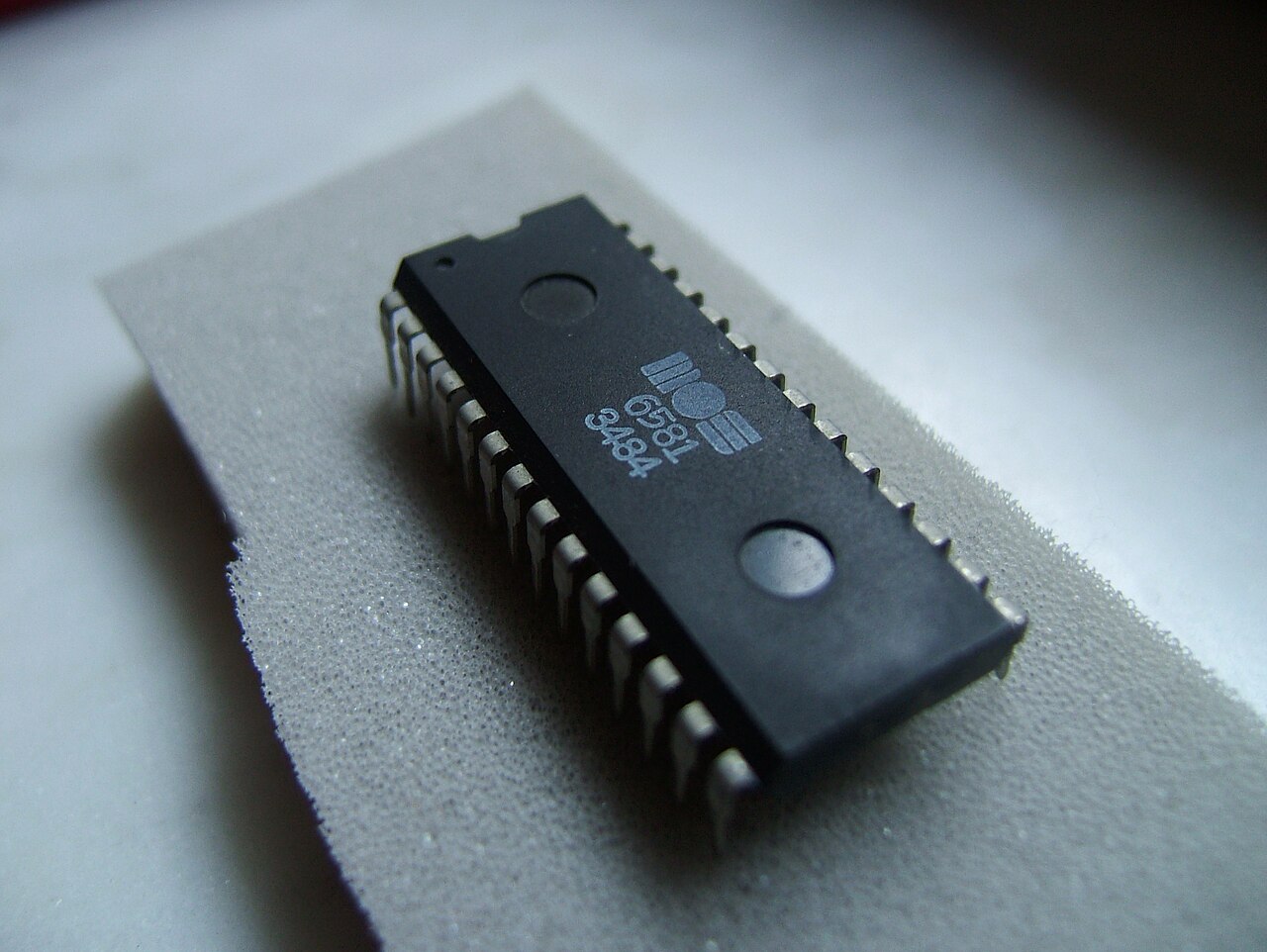
Bob Yannes (born 1957), an electronic-music hobbyist hired as a chip designer at MOS Technology, designed the 6581 SID (Sound Interface Device), the sound chip of the Commodore 64. He wanted “a chip that was a music synthesizer,” not a beeper for games, and in about five months in 1981 he put three voices with four waveforms, independent volume envelopes, ring modulation and a multimode analog filter on one piece of silicon. He ran out of time for the filter, and the published specification was so garbled that some early games used it wrongly. The Commodore 64 went on to sell more units than any other single computer model, and in the hands of composers such as Rob Hubbard, Martin Galway and Chris Hülsbeck the SID gave a generation its sound of home-computer music. Yannes, who as late as 1996 had still not heard their work, left Commodore in 1983 and co-founded the synthesizer company Ensoniq.
A Hobbyist at MOS
Robert Yannes was born in 1957 and graduated in electrical engineering from Villanova University in 1978. He had built electronic music equipment as a hobby for years, and was influenced, he later said, by Emerson, Lake & Palmer’s “Lucky Man” more than any other single song, and by Kraftwerk and Mike Oldfield. When he joined MOS Technology, Commodore’s semiconductor company, he knew nothing about designing integrated circuits. Albert Charpentier, who ran MOS’s chip design group, hired him partly because his knowledge of music synthesis was thought useful for future products.
Before the SID, Yannes designed the MicroPET, a small computer built from a spare prototype board, which became the unplanned prototype for Commodore’s VIC-20 (see Jack Tramiel and Commodore).
Five Months
In January 1981 Charpentier’s group began designing two chips: a graphics chip, the VIC-II, which Charpentier led himself, and a sound chip, which Yannes was asked to design. Both were intended for a video game or to be sold to other manufacturers. “We were fresh out of ideas for whatever chips the rest of the world might want us to do,” Charpentier recalled. Yannes worked with two draftsmen and a CAD operator, and in 1985 he told IEEE Spectrum that the actual design “only took about four or five months.” MOS had its own fabrication line next to the designers, so a change could be tried in silicon quickly and cheaply. The constraint, Yannes said in 1996, “wasn’t budget, it was development time and chip size.”
He had little respect for the sound chips then on the market. “I’d worked with synthesizers, and I wanted a chip that was a music synthesizer.” Most game sound effects of the time were either at full volume or off, which made music impossible. The SID was designed as one voice of a polyphonic synthesizer, multiplied by three: each voice had its own oscillator, waveform selector, envelope generator and amplitude control.
- Oscillators. Each voice used a 24-bit phase accumulator with 16 bits of programmable frequency, which gave precise pitch control. An exponential lookup table to produce the notes of the equal-tempered scale directly was dropped because it took too much silicon; software had to supply the frequencies.
- Waveforms. Sawtooth, triangle, pulse with variable width, and noise from a 23-bit pseudo-random shift register. Selecting several waveforms at once combined their bits with a logical AND, which gave unpredictable results and could lock up the noise generator.
- Envelopes. Each voice had a hardware ADSR envelope (attack, decay, sustain, release) driven by an 8-bit counter, with the four rates packed into two bytes, so a note could swell and fade without the processor’s help.
- Modulation. Hard sync and ring modulation let one oscillator shape another, producing metallic and bell-like timbres.
- Filter. An analog state-variable filter with simultaneous low-pass, band-pass and high-pass outputs, programmable cutoff and resonance; combining low-pass and high-pass gave a notch.
- Volume. A 4-bit master volume register, which programmers later discovered they could rewrite rapidly to play back digitized samples.
The filter was the last part. “I ran out of time,” Yannes told Spectrum. NMOS, the process MOS used, could not make good operational amplifiers, so he used field-effect transistors as voltage-controlled resistors. Their resistance varied from one production lot to another, so the cutoff frequency of the filter differed from chip to chip, and a tune that sounded right on one Commodore 64 sounded muffled on another. He called it “the worst part of SID.” There was also leakage: a voice set to zero volume was not quite silent.
The Commodore 64
The two chips were finished in mid-November 1981. Later that month Jack Tramiel, Commodore’s president, decided that instead of selling them as components, Commodore would build its own home computer around them, with 64 kilobytes of memory. The engineers laid out the architecture in two days and had five working prototypes just before the new year. The Commodore 64 was shown at the Winter Consumer Electronics Show in Las Vegas in January 1982 at $595, and volume shipments began in August 1982. It sold, by Commodore’s own estimate, 17 million units, and by its shipment records perhaps 12.5 million, either way more than any other single computer model (see The Best-Selling Computer: Commodore 64).
The SID’s documentation did not survive the rush. “The spec sheet got distributed and copied and rewritten by various people until it made practically no sense anymore,” Yannes said. It wrongly suggested that waveforms could be mixed, and its filter equations, he said, “didn’t hang together.” Some Japanese programmers wrote their early games from an early spec sheet Yannes had written himself, which was inaccurate, and their sound effects came out out of tune or muffled. From about 1986 newer machines used a revised chip, the 8580, and music written for one version can sound different on the other.
The Composers
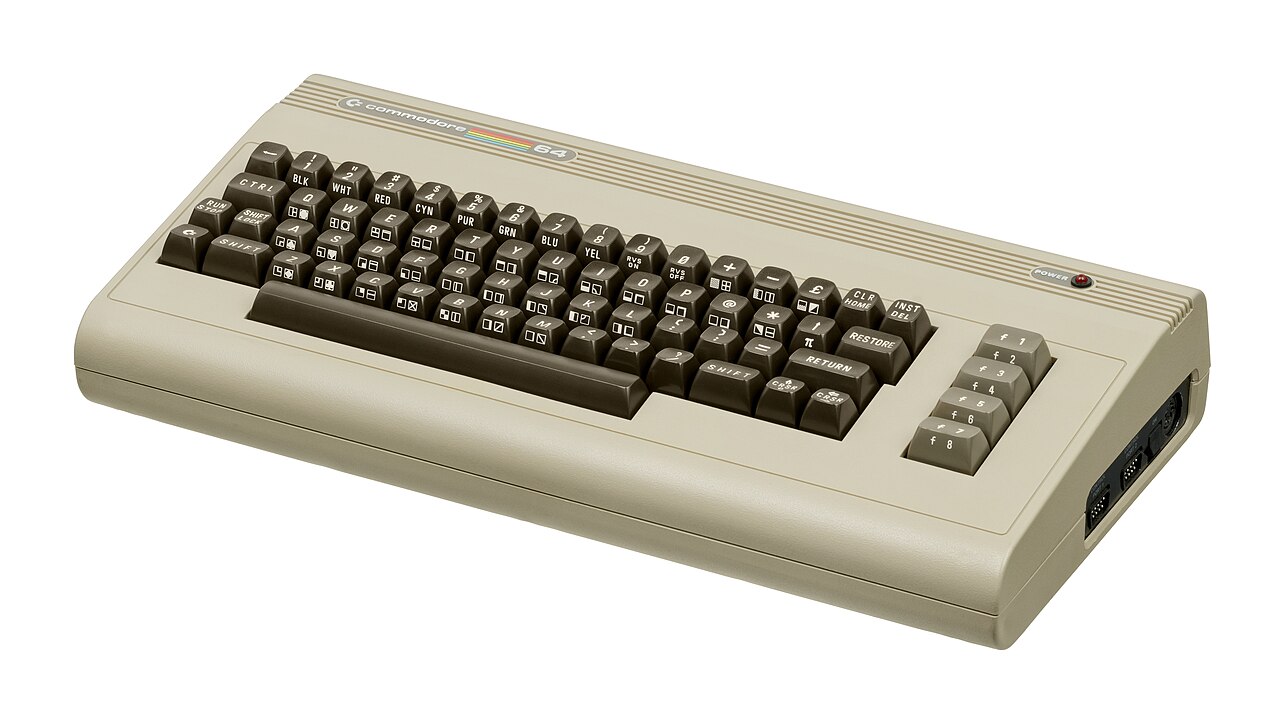
The SID was designed for musicians, and in Britain and Germany from the mid-1980s a small number of young composers, writing their own playback routines in 6502 machine code, made it their instrument. Rob Hubbard, born in 1955 in Hull, wrote his first game theme for Thing on a Spring in 1985, followed the same year by Monty on the Run and Commando, and later Sanxion and Delta; he used rapid changes of the volume register to play back crude but clear samples. Martin Galway, born in Belfast in 1966, scored Ocean Software games including Parallax (1986) and Wizball (1987); his theme for the C64 Arkanoid (1987) is credited as the first published use of sampled sounds on the machine. In West Germany Chris Hülsbeck, born in Kassel in 1968, won a competition run by the magazine 64’er in 1986 with his piece Shades, which got him a job at Rainbow Arts; the same year he released SoundMonitor, a music program for the C64, and in 1987 he wrote the music for The Great Giana Sisters. Tim Follin and the Dutch composer Jeroen Tel belonged to the same scene.
Their techniques went far beyond what the chip’s three voices suggested: arpeggios cycled through the notes of a chord so fast that one voice sounded like three, pulse-width modulation made a single waveform shimmer, and filter sweeps and ring modulation gave tunes their characteristic growl. Programmers made the SID speak too, most famously in the 1984 game Ghostbusters (see The History of Speech Synthesis). The demoscene took the music further after the games were forgotten (see The Demoscene).
Misconception: Bob Yannes invented chiptune
Yannes designed the instrument, not the music. He had left Commodore by 1983 and, as he said in a 1996 interview, had never heard the work of Hubbard, Galway, Follin or Tel; he asked whether their recordings were available in the United States. The style now called chiptune was created by composers on several machines, the Commodore 64 among the most important, who exploited properties of the SID, such as the sample playback through the volume register, that its designer had not intended. See Myths and Misconceptions.
The music outlived the machine. In 1989 PlaySID on the Amiga played C64 tunes by emulating the chip, and later SIDPlay and the reSID engine (1998) emulated its filter and distortion in software on PCs. The High Voltage SID Collection, maintained by volunteers, has archived tens of thousands of SID tunes. Because the 6581 is no longer made, original chips are traded, counterfeited and replaced by modern equivalents such as the SwinSID, and the Swedish company Elektron built its SidStation synthesizer of 1997 around the 6581.
Ensoniq
Yannes left Commodore in the spring of 1983. With Charpentier, Bruce Crockett and other members of the Commodore 64 design team, who had fallen out with Tramiel after he rejected their proposal for a new home computer, he formed a company called Peripheral Visions, soon renamed Ensoniq. Its first plan, a keyboard for the Atari 2600, died in the video game crash of 1983, and the sound chip they had been developing for it, the Digital Oscillator Chip (DOC), became the basis of their first synthesizer.
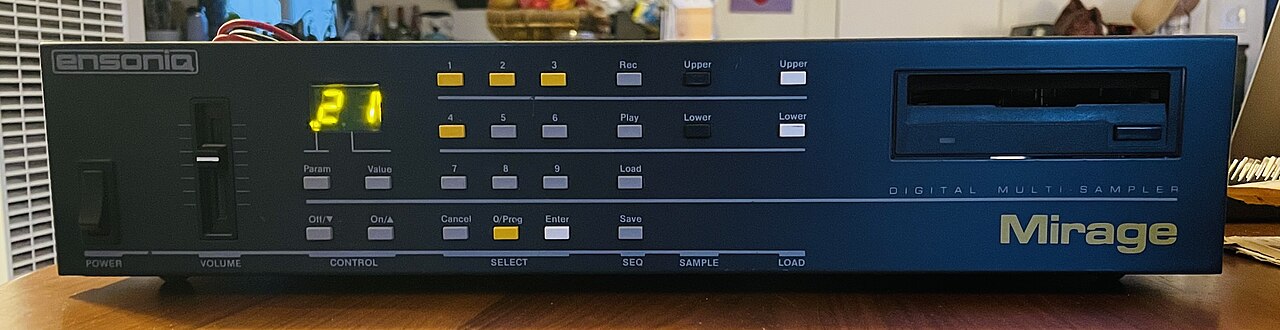
The Mirage of 1985 was a sampling keyboard for $1,695, far cheaper than any sampler before it, and it sold about 8,000 units in its first year. The ESQ-1 followed in 1986 and the VFX in 1989. Under an agreement of 1986 Apple put the DOC into the Apple IIGS. Ensoniq’s chips multiplexed their oscillators to produce at least 32 voices per chip, which the SID, built in a hurry, had not done; the later designs added waveform interpolation, digital filters and effects. Ensoniq also made PC sound cards, and in January 1998 Creative Technology bought the company for $77 million, mainly for its AudioPCI sound-card technology. The musical-instrument division was merged with E-mu Systems and dissolved after 2002 (see Computing and Music Creation).
Looking back in 1996, Yannes thought the SID had had “not much impact on the synthesizer industry”: Sequential Circuits had been interested in buying the chip, but nothing came of it, and nearly all of the production went into Commodore 64s. He owned several of the computers, he said, but had not turned them on in years.
📚 Sources
- Perry, Tekla S. & Wallich, Paul: “Design Case History: The Commodore 64,” IEEE Spectrum, March 1985, republished as “Creating the Commodore 64: The Engineers’ Story” (Yannes and Charpentier quotes, January 1981 start, team, November 1981, Tramiel’s decision, prototypes, CES, $595, August 1982 shipments, spec sheet and Japanese games, “I ran out of time”)
- “Chip Hall of Fame: MOS Technology 6581,” IEEE Spectrum (on-site fab, frequency control and envelopes, Ghostbusters speech, documentation, spec-sheet quote)
- Varga, Andreas: “Interview with Bob Yannes,” e-mail interview, August 1996 (hobbyist background, design goals, constraints, architecture of oscillators, waveforms, envelopes, filter, “the worst part of SID,” Japanese games, the composers, Sequential Circuits, Ensoniq)
- Bob Yannes, Wikipedia (birth year, Villanova 1978, Charpentier, MicroPET, influences, Ensoniq chips)
- MOS Technology 6581, Wikipedia (five months in late 1981, CES 1982, Yannes leaves spring 1983, 8580 from 1986, PlaySID 1989, reSID 1998, SidStation 1997, HVSC)
- Ensoniq, Wikipedia (Peripheral Visions in spring 1983, founders, Tramiel, Atari 2600 keyboard, DOC, Mirage $1,695 and 8,000 units, ESQ-1, VFX, Apple IIGS, Creative acquisition January 1998 for $77 million)
- Rob Hubbard, Wikipedia
- Martin Galway, Wikipedia
- Chris Hülsbeck, Wikipedia
- High Voltage SID Collection
- Image: Ensoniq Mirage DMS-8.jpg by Alison Cassidy (CC BY-SA 4.0), via Wikimedia Commons