John Atanasoff and the ABC
Abstract
John Vincent Atanasoff (1903–1995), a physics professor at Iowa State College, built the first machine to compute electronically in binary: the Atanasoff-Berry Computer (ABC), constructed with his graduate student Clifford Berry between 1939 and 1942. It solved systems of linear equations, stored its numbers in capacitors that were periodically refreshed (the principle of today’s DRAM), and was neither programmable nor fully reliable. Iowa State never filed the patent, Atanasoff left for wartime navy work, and the machine was dismantled around 1948 without anyone telling him. In June 1941 John Mauchly, later co-designer of ENIAC, spent four days in Ames studying it. In 1973 a federal judge cited that visit when he declared the ENIAC patent invalid, and the forgotten professor became a public figure at 70.
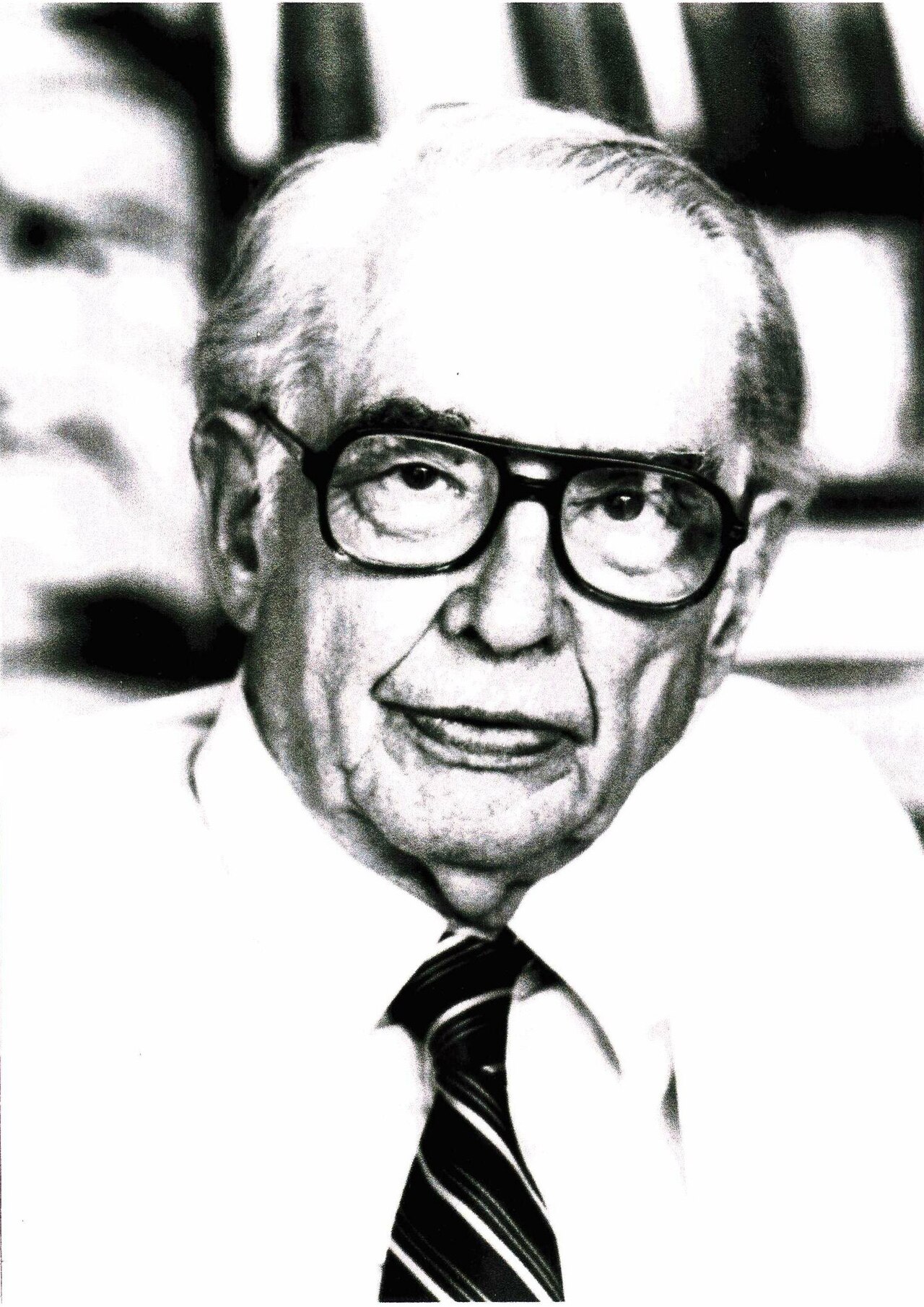
Brewster, Florida
John Vincent Atanasoff was born on 4 October 1903 in Hamilton, New York. His father, Ivan Atanasov, had been born in 1876 in Boyadzhik near Yambol, in what is now Bulgaria, came to the United States in 1889 and became an electrical engineer; his mother, Iva Lucena Purdy, taught mathematics. The family moved often and settled in Brewster, Florida, where their house was the first they had lived in with electricity. By the age of nine John had taught himself to repair its wiring and had learned to use his father’s slide rule. His mother showed him how to write numbers in bases other than ten, including base two. He finished high school in two years.
He entered the University of Florida in 1921 wanting to study theoretical physics, and since the university offered no physics degree he took electrical engineering, graduating in 1925. Iowa State College in Ames gave him a master’s degree in mathematics in 1926; a few days later he married Lura Meeks. He then went to the University of Wisconsin, where he took a doctorate in theoretical physics in 1930 with a thesis on The Dielectric Constant of Helium, and returned to Iowa State to teach mathematics and physics.
The thesis decided the rest of his career. He did its calculations on a Monroe mechanical calculator, the best desk machine of the day, and he concluded that there had to be a better way to compute.
The Search for a Machine
Through the 1930s Atanasoff tried the methods available. With the Iowa State statistician A. E. Brandt he modified an IBM tabulator to analyse complex spectra, and published the work in 1936 (IBM, he later learned, did not like its machines being used for purposes it had not intended; see Herman Hollerith and the Punched Card). With two colleagues he built a small analog calculator, the “laplaciometer,” for analysing surface geometry. It gave accurate results, but only while every mechanical part was in perfect order, and that made him distrust analog methods.
His target problem was the system of simultaneous linear equations, which turned up everywhere in physics and engineering and grew unmanageable by hand. In his 1940 funding proposal he estimated that an expert human computer needed about eight hours to solve eight equations in eight unknowns, and that twenty equations would take 125 hours. Systems of more than ten unknowns, he wrote, were rarely attempted, “but this is precisely what is needed” to make approximate methods useful in practical problems.
The Roadhouse
Atanasoff told the story of how the design came together many times, and it rests on his own account. One evening in the winter of 1937–38, frustrated that his work had stalled, he left his office and started driving. He drove east across Iowa, past Tama and Iowa City, until he was crossing the Mississippi into Illinois at the three river cities, one of which is Rock Island. Iowa was dry; Illinois was not. Near Rock Island he turned off the highway and stopped at a roadhouse with bright lights. Over a drink, he recalled, he found himself relaxed for the first time in months, and his thoughts turned again to computing machines.
That evening, by his account, he settled four questions:
- The machine would use electricity and electronics as its medium.
- It would use base-two numbers, “in spite of custom.”
- It would store numbers in condensers (capacitors) and use a regenerative or “jogging” process to restore their charge before it leaked away.
- It would compute by direct logical action rather than by counting, the method of the existing calculating devices.
The popular version adds a cocktail napkin on which he wrote the ideas down, and has him drinking bourbon and soda; neither detail is in the contemporary record, and the accounts differ on the drink. The four decisions themselves are documented in his later testimony and writing, and all four describe features of the machine he built.
The ABC
In March 1939 Atanasoff applied to Iowa State for money to hire a graduate assistant and buy materials, and the college granted $650. He hired Clifford Edward Berry, born on 19 April 1918 in Gladbrook, Iowa a high-school valedictorian who graduated in electrical engineering that year. In October 1939 they had an 11-tube prototype working, and in December they demonstrated it to college officials, which brought funding for a full-size machine. The Research Corporation of New York added a grant of about $5,000.
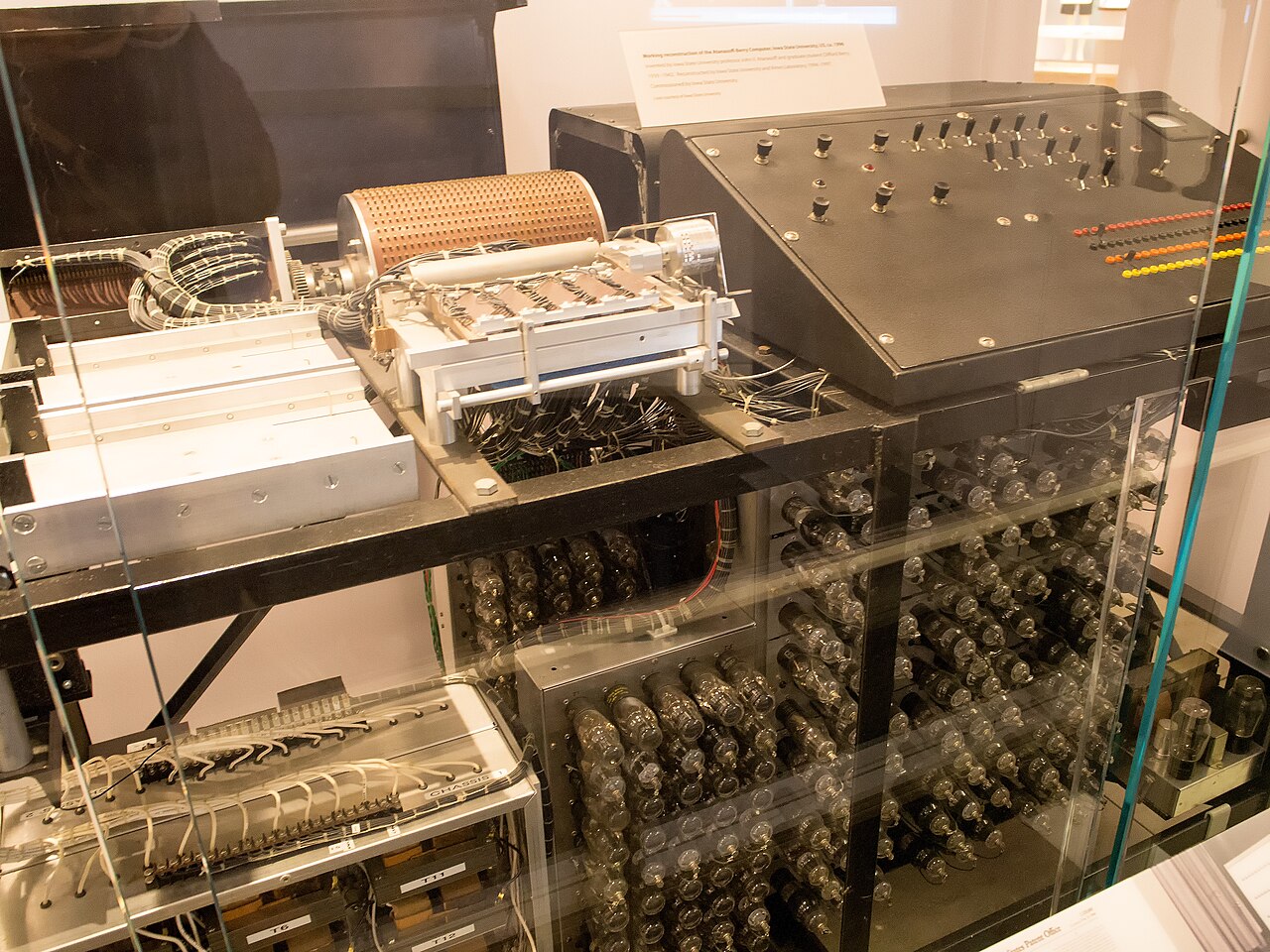
Atanasoff and Berry built the full machine in the basement of the physics building between 1939 and 1942. It was about the size of a desk and weighed more than 700 pounds. Its memory was two drums, each carrying 1,600 capacitors in 32 bands of 50, of which 30 bands were in use and two were spares. Each band held one 50-bit binary number, so the machine stored 60 numbers at once. The drums turned once a second on a common shaft, and as each capacitor passed the brushes, its charge was read and restored, the “jogging” of the roadhouse evening. Modern dynamic RAM uses the same principle: a capacitor holds the bit and must be refreshed.
The arithmetic was electronic. Thirty add-subtract units, built from about 280 dual-triode vacuum tubes and 31 thyratrons, worked on the 30 numbers of a band in parallel, one bit at a time, keeping each carry in a capacitor for the next step. The 60-cycle mains frequency served as the clock. The machine read its input in decimal from standard IBM punched cards, converted it to binary, and displayed its results in decimal on the front panel. There was no program: an operator set the sequence of operations with switches. Its single task was Gaussian elimination, eliminating one variable at a time from pairs of equations, and it could handle up to 29 equations in 29 unknowns.
The weak point was intermediate storage. A system of that size produced far more partial results than two drums could hold, so the ABC wrote them to sheets of paper, marking up to 1,500 positions per sheet with high-voltage sparks from thyratron-driven electrodes, and read them back later by passing the sheet between electrodes at a lower voltage. The sheets misread about once in 100,000 operations. For a machine performing a long elimination, that was enough to spoil a large problem, and the fault was never cured; the obvious remedy, adding a check bit to each number, was not built before Atanasoff left. The ABC worked as a machine; it never reached reliable production use.
In late spring 1940 Atanasoff and Berry wrote a 35-page manuscript describing the machine in detail, both to obtain more funding and as the basis for a patent. Iowa State, which held the majority of the rights, hired a Chicago patent attorney, Richard Trexler. The application was never filed.
Mauchly in Ames
In December 1940 Atanasoff attended the meeting of the American Association for the Advancement of Science in Philadelphia and heard John Mauchly, a physicist at Ursinus College, describe his harmonic analyser for weather data. Afterwards they talked about computing machines. Atanasoff, cautioned by the college and its patent attorney, would not explain his machine in detail, but he invited Mauchly to come to Ames and see it.
Mauchly arrived on 13 June 1941 and stayed four days as Atanasoff’s house guest. He saw the ABC, discussed its design with Atanasoff and Berry at length, and read the 35-page manuscript, taking notes; Atanasoff refused to let him take a copy until the patent was filed. Atanasoff later said he had trusted Mauchly as a fellow scientist, as he had trusted other visitors such as Samuel Caldwell of MIT. Mauchly later said the ABC had not impressed him and that his own ideas about electronic computing predated the visit.
After Pearl Harbor the project ended. Berry finished his master’s degree in physics in 1941, married Atanasoff’s secretary Martha Jean Reed in 1942, and took a defense job in California. Atanasoff went to the Naval Ordnance Laboratory in Washington as a civilian, as chief of its acoustics division, and left the patent in the hands of Iowa State and Trexler. In Washington Mauchly visited him several times in 1943; only in early 1944 did he mention that he was working on a computer of his own. That machine was ENIAC, which Mauchly and J. Presper Eckert built at the University of Pennsylvania (see ENIAC and the First Electronic Computers).
The Lost Machine
In 1945 the Navy decided to build a large computer and put Atanasoff in charge. In July 1946 he took part in the atomic bomb tests at Bikini Atoll, and soon afterwards the Navy’s computer project was shut down. He never returned to computing.
Around 1948 Iowa State cleared the physics basement for classrooms. The ABC was dismantled and thrown away, except for one memory drum and a few parts. Neither Atanasoff nor Berry was told. One reason the machine was not moved intact was its size: the frame was too wide to pass through a standard door.
Atanasoff’s later career was in military engineering. In 1952 he founded the Ordnance Engineering Corporation, which he sold in 1956 to Aerojet General, becoming president of its Atlantic division; in 1961 he retired from Aerojet and founded Cybernetics Incorporated in Frederick, Maryland, which he ran for about twenty years. Berry earned his doctorate in physics in 1948 and later moved to New York, where he died on 30 October 1963, aged 45, in what was recorded as a possible suicide.
Honeywell v. Sperry Rand
The ABC returned through a patent. Eckert and Mauchly had filed for a patent on ENIAC on 26 June 1947, and it was finally granted on 4 February 1964, as US Patent 3,120,606. By then it belonged to Sperry Rand, which used it to demand royalties from the rest of the computer industry. An IBM attorney had already asked Atanasoff for help with a case against the Eckert-Mauchly patents in 1954, and from then until 1973 he testified repeatedly in the litigation over them.
On 26 May 1967 Sperry Rand sued Honeywell in Washington and Honeywell sued Sperry Rand in Minneapolis, minutes earlier. The Minneapolis trial before Judge Earl R. Larson ran from 1 June 1971 to 13 March 1972: 135 days of testimony from 77 witnesses, depositions from 80 more, a 20,667-page transcript and more than 32,000 exhibits. Atanasoff and Mauchly’s four days in Ames were at the centre of Honeywell’s case.
Larson published his decision on 19 October 1973. He declared the ENIAC patent invalid on several grounds: ENIAC had been in public use and on sale more than a year before the application, and its inventors had derived their subject matter from someone else. Eckert and Mauchly, he found, had not invented the automatic electronic computer themselves, but had “derived that subject matter from one Dr. John Vincent Atanasoff.” The decision appeared the day before the Saturday Night Massacre of the Watergate affair and was hardly reported.
Misconception: A court ruled that Atanasoff invented the computer
Honeywell v. Sperry Rand decided whether a patent was valid, not who deserves a title in history. Larson’s derivation finding was one of several independent reasons to void the ENIAC patent; it did not compare the ABC with ENIAC as computers, and it did not declare the ABC the first computer. The ABC was electronic and binary, but it was not programmable, could do one kind of problem, and never worked reliably at full size; ENIAC was programmable, general-purpose and ran for years. Even the year of the ruling has drifted in retelling: a 2010 biography gives 1978. See Myths and Misconceptions.
Recognition
Bulgaria honoured him first. In 1970 the Bulgarian Academy of Sciences invited him to Sofia and awarded him the Order of Saints Cyril and Methodius, First Class; he visited again in 1975 and 1985, when he became a foreign member of the Academy and an honorary citizen of his father’s town, Yambol. In the United States the Smithsonian’s Computer Oral History project interviewed him in several sessions in 1972. He received the IEEE Computer Pioneer Medal in 1981, and in 1984 he published his own account of the machine, “Advent of Electronic Digital Computing,” in the Annals of the History of Computing. The journalist Clark Mollenhoff, who had covered the trial, published Atanasoff: Forgotten Father of the Computer in 1988. The ABC was dedicated as an IEEE Milestone in Ames on 1 April 1990, and the same year President George H. W. Bush presented Atanasoff with the National Medal of Technology.
Between 1994 and 1997 a team led by John Gustafson and Delwyn Bluhm of the Ames Laboratory rebuilt the ABC from patent drafts, purchase orders, photographs and the surviving drum, for about $300,000 to $350,000 by different accounts. They made one change: the frame was narrowed to fit through a door. The reconstruction later went to the Computer History Museum in Mountain View. Atanasoff did not see it finished. He died of a stroke at his home in Frederick County, Maryland, on 15 June 1995, aged 91.
Where Atanasoff stands depends on what one counts as a computer. Konrad Zuse’s Z3 of 1941 was programmable but used relays (see Konrad Zuse and the Z3); Colossus of 1943–44 was electronic and programmable within its codebreaking task (see Tommy Flowers and Colossus); ENIAC was electronic, general-purpose and in sustained operation. The ABC was the first machine to compute with vacuum tubes in binary and the first to use a refreshed capacitor memory, built by two men on a few thousand dollars of grants. Gordon Bell has called the court case the “disinvention” of the computer: after 1973 nobody held a patent on the electronic digital computer.
📚 Sources
- John Vincent Atanasoff, Wikipedia (family, education, NOL, Bikini, companies, honours, death)
- Atanasoff–Berry computer, Wikipedia (drums, tube counts, weight, spark-written paper sheets, error rate, 29 equations, grants, dismantling, replica, patent dates)
- Atanasoff, J. V.: “Advent of Electronic Digital Computing,” Annals of the History of Computing, Vol. 6, No. 3, 1984
- John V. Atanasoff, ETHW (Engineering and Technology History Wiki) (Brewster, electricity, slide rule, number bases, Florida, Wisconsin, Monroe calculator)
- “Atanasoff-Berry Computer Operation/Purpose,” Iowa State University Department of Computer Science (IBM tabulator, laplaciometer, the four ideas, $650 grant, 1940 manuscript, unfiled patent, 1940 proposal quote)
- “John Mauchly Visits Ames,” Iowa State University Department of Computer Science (December 1940 meeting, Trexler, 13 June 1941 visit, four days, manuscript)
- John Vincent Atanasoff Papers, RS 13/20/51, Iowa State University Special Collections (marriage, dismantling without notice, honours)
- Gustafson, John: “Reconstruction of the Atanasoff-Berry Computer” (design in modern terms, spark-marked paper sheets, reconstruction cost, the door)
- “Excerpt: ‘The Man Who Invented The Computer’,” NPR, 19 November 2010 (Jane Smiley’s account of the drive, Atanasoff’s recollection of the roadhouse)
- “Atanasoff-Berry Computer,” Computer History Museum, Revolution exhibition (napkin story, door width, 30 add-subtract circuits, Gordon Bell’s “disinvention”)
- Clifford Berry, Wikipedia (birth, degrees, marriage, death)
- Honeywell, Inc. v. Sperry Rand Corp., Wikipedia (filing, trial length, witnesses, exhibits, decision date, findings, Watergate)
- McTiernan, Charles: “The ENIAC Patent,” IEEE Annals of the History of Computing, Vol. 20, No. 2, 1998
- Milestones: Atanasoff-Berry Computer, 1939, ETHW (dedicated 1 April 1990)
- Tropp, Henry S.: Interview with John V. Atanasoff, 18 February 1972, Computer Oral History Collection, Archives Center, National Museum of American History
- “Computer pioneer Atanasoff dies,” Associated Press via The Virginian-Pilot, 17 June 1995
- Jacobs, Alan: “The Man Who Delivered the Computer,” Christianity Today (review of Jane Smiley’s 2010 biography, quoting its “affirmed in court in 1978”)
- Mollenhoff, Clark R.: Atanasoff: Forgotten Father of the Computer, Iowa State University Press, 1988
- Image: ATANASOFF Pic^1 - Flickr - Eye Steel Film.jpg by Eye Steel Film from Canada (CC BY 2.0), via Wikimedia Commons
- Image: Atanasoff-Berry Computer ー Computer History Museum (30781535612).jpg by Ik T from Kanagawa, Japan (CC BY 2.0), via Wikimedia Commons