Ross Freeman and the FPGA
Abstract
Ross Freeman (1948–1989), an engineer at Zilog, proposed a chip that its user could rewire: an array of small logic blocks in a sea of programmable connections, configured by loading a pattern of bits into on-chip memory. Many of its transistors would go unused in any given design, which chip designers regarded as heresy. Freeman bet that Moore’s law would make transistors cheap enough not to matter. Zilog was not interested, so in February 1984 he co-founded Xilinx with Bernard Vonderschmitt and James Barnett, filed his patent on 12 March 1984, and in November 1985 the company announced the XC2064, the first field-programmable gate array (FPGA). The patent was granted on 26 September 1989; Freeman died four weeks later, aged 41. FPGAs became a market of billions of dollars a year, Intel and AMD bought the two largest makers for $16.7 billion and about $50 billion, and in 2009 Freeman was inducted into the National Inventors Hall of Fame.
Engadine
Ross Freeman was born on 26 July 1948 in Michigan’s Upper Peninsula and grew up on a farm near Engadine. He studied physics at Michigan State University, graduating in 1969, and took a master’s degree at the University of Illinois in 1971. He then spent several years as a Peace Corps volunteer in Ghana, teaching mathematics and electronics.
Back in the United States he joined Teletype Corporation, where he designed a custom PMOS integrated circuit, and then moved to Zilog, the microprocessor company that Federico Faggin had founded after leaving Intel (see Federico Faggin and the Microprocessor). In his early thirties he was director of engineering for Zilog’s components division, and later a vice-president and general manager.
The Idea
In the early 1980s a designer who needed custom digital logic had three choices. Standard logic chips, the 7400-series TTL parts with a few gates each, were cheap and flexible but took dozens of packages and a large circuit board for anything complicated. Programmable logic devices such as the PAL could replace several of them, but held only a few hundred gates’ worth of logic in a fixed two-level structure. A gate array or fully custom chip from a semiconductor maker gave any logic the designer wanted, but required months of work, expensive tooling and a large order, and any mistake meant doing it all again.
Freeman’s idea at Zilog was a chip that combined the density of a gate array with the flexibility of software. It would contain a grid of identical configurable logic blocks, each able to compute any function of a few inputs, surrounded by programmable wiring and input/output blocks. The function of each block and the routing of every connection would be set by bits held in static memory cells spread across the chip, loaded from an external memory each time the power came on. Change the bits and the chip became a different circuit, in seconds, on the customer’s own bench: programmable in the field.
The cost was transistors. A gate array used nearly all its silicon for the user’s logic; Freeman’s chip spent most of its area on configuration memory, multiplexers and switches, and any particular design would leave many logic blocks idle. In a period when chip designers worked to minimize every transistor, this was, as IEEE Spectrum later put it, heresy. Freeman’s argument rested on Moore’s law (see Gordon Moore and Moore’s Law): transistors were getting cheaper every year, engineers’ time was not, and a chip that wasted silicon but saved months of design would become the cheaper option. Zilog did not want to pursue it.
Xilinx
Freeman left. In February 1984 he founded Xilinx in San Jose with two Zilog colleagues: James V. Barnett II and Bernard Vonderschmitt, who became chief executive. Vonderschmitt had spent more than three decades at RCA, where he had headed the Solid State Division and licensed RCA’s CMOS process to Seiko Epson in Japan, and he had vowed that if he ever started a semiconductor company, it would not own a factory. Xilinx became one of the first fabless chip companies: it designed chips and paid others to make them. Vonderschmitt’s friendship with the Seiko Epson executive Saburo Kusama brought the first manufacturing contract, on a CMOS process designed for watch chips.
Freeman filed his patent application on 12 March 1984. It described a “configurable electrical circuit having configurable logic elements and configurable interconnects.”
The XC2064
The chip was designed by Bill Carter, recruited from Zilog as Xilinx’s eighth employee, after the three founders and three software engineers. Carter was a microprocessor designer with no background in programmable logic, and when Freeman first explained the idea to him, Carter recalled, his reaction was: “This is the stupidest thing I’ve ever heard of in my life!” He joined anyway and started the design in March 1984.
The first concept was an 8-by-8 array of logic elements in a sea of programmable interconnect. The team chose look-up tables for the logic: a small memory that holds the output value for every combination of inputs and can therefore implement any function of them. When they mapped existing customer designs onto the architecture by hand, they found far more interconnect than needed and removed much of it. Carter drew the layout polygons by hand and sent them out to be digitized; even Vonderschmitt was given the homework of mapping an example circuit onto the logic blocks with coloured pencils.
The result had 64 configurable logic blocks, 58 input/output blocks and about 85,000 transistors. It taped out in late May 1985. The first box of 25 wafers arrived in early July, and the first ten were dead, with shorts between power and ground; the eleventh drew enormous current, and the remaining fourteen were dead too. The cause was aluminium whiskers between metal lines, which the team burned away by driving a large current through the chip. Carter then loaded a configuration that turned one logic block into an inverter, and the chip signalled that it was configured. The team called it the world’s most expensive inverter.
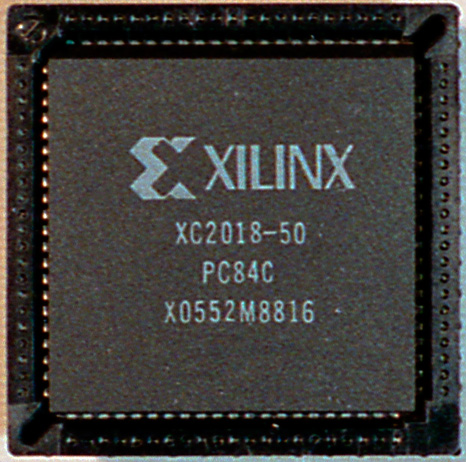
Xilinx began shipping on 31 October 1985 and announced the XC2064 on 1 November as the world’s first “Logic Cell Array.” The press release compared it with PAL devices of 150 to 300 equivalent gates and claimed it could replace 15 to 75 standard logic chips or four or more PALs. The large die forced a premium price, and adoption was slow: early FPGAs were slower than TTL and PAL parts, and designers did not know the software tools. Xilinx and Carter’s team described the device at the Custom Integrated Circuits Conference in 1986, and the XC2018, with 100 logic blocks, followed the same year.
Four Weeks
Freeman did not see the industry grow. His patent, US 4,870,302, a continuation of the 1984 application, was granted on 26 September 1989. He died on 22 October 1989, aged 41.
The Industry
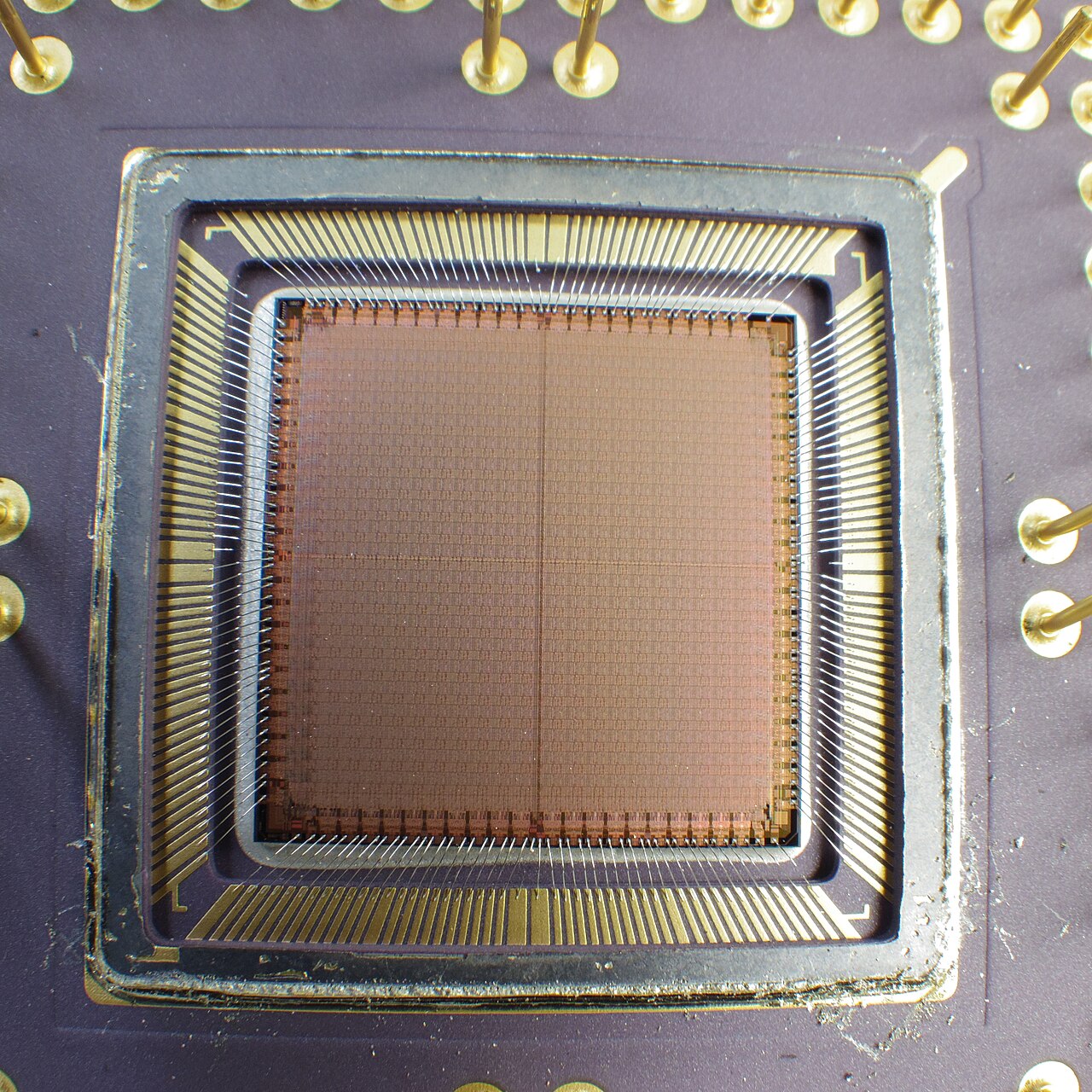
The industry he started grew quickly. Its main competitor became Altera, founded in 1983, whose first product in 1984 was a reprogrammable logic device erased with ultraviolet light. The FPGA market was worth about $14 million in 1987, $1.9 billion in 2005 and $5.4 billion in 2013, when Xilinx and Altera held 36 and 31 percent of it. FPGAs went first into telecommunications and networking equipment, where standards changed faster than custom chips could be designed, then into cars, industrial control, consumer products, radio astronomy and, from 2014, Microsoft’s data centres, where they accelerated the Bing search engine and later Azure workloads.
On 1 June 2015 Intel announced that it would buy Altera for about $16.7 billion. On 27 October 2020 AMD announced its purchase of Xilinx, completed in February 2022 at a value of about $50 billion; AMD retired the Xilinx name in 2023.
Recognition
Since 1992 Xilinx has given an annual Ross Freeman Award for Technical Innovation to one of its engineers, chosen by a vote of the company’s technical staff. In 2009 IEEE Spectrum listed the XC2064 among its “25 Microchips That Shook the World,” and in 2017 the magazine added it to its Chip Hall of Fame. Freeman was inducted into the National Inventors Hall of Fame in 2009, twenty years after his death. In Bill Carter’s oral history for the Computer History Museum, recorded in 2015, the chip’s designer described what he had learned from Freeman and from Vonderschmitt.
On 12 March 2026, the 42nd anniversary of the patent’s priority date, the IEEE dedicated the FPGA as an IEEE Milestone in San Jose.
📚 Sources
- Ross Freeman, National Inventors Hall of Fame (dates, education, Peace Corps in Ghana, Teletype, Zilog, Xilinx, the Moore’s law argument; inducted 2009)
- Ross Freeman, Wikipedia (Upper Peninsula, Engadine, degrees, Teletype PMOS circuit, Xilinx founders, patent, Ross Freeman Award)
- Freeman, Ross H.: US Patent 4,870,302, “Configurable electrical circuit having configurable logic elements and configurable interconnects,” priority 12 March 1984, filed 19 February 1988, granted 26 September 1989
- Milestones: The Field Programmable Gate Array (FPGA), 1984, ETHW (priority date, founders, Vonderschmitt as CEO, XC2064 press release of 1 November 1985, fabless model, dedication 12 March 2026)
- “How the FPGA Came to Be, Part 5,” EE Journal (Zilog, February 1984 founding, Vonderschmitt and RCA, Seiko Epson and Kusama, XC2064 specifications, first silicon, whiskers, “world’s most expensive inverter,” press release, slow adoption)
- “Bill Carter remembers the first FPGA,” EDN (eighth employee, “stupidest thing,” design from March 1984, hand-drawn layout, first silicon July 1985, shipping 31 October 1985)
- “Chip Hall of Fame: Xilinx XC2064 FPGA,” IEEE Spectrum, 2017 (transistor “heresy,” Vonderschmitt’s homework, AMD and the Xilinx brand)
- Field-programmable gate array, Wikipedia (Altera 1983, XC2064 with 64 CLBs, market figures, Intel/Altera and AMD/Xilinx acquisitions, applications)
- Trimberger, Stephen M.: Oral history of Bill Carter, Computer History Museum, 13 July 2015, catalog 102737927
- “Xilinx Co-Founder Ross Freeman Honored as 2009 National Inventors Hall of Fame Inductee for Invention of FPGA,” Xilinx press release, February 2009
- Image: FPGA chip die (Xilinx XC4010-6) (22054207552).jpg by htomari (CC BY-SA 2.0), via Wikimedia Commons