Brazil's Market Reserve
Abstract
From 1977 to 1992 Brazil reserved the market for minicomputers, and later microcomputers and software, for companies controlled by Brazilians. The reserva de mercado began as an administrative policy of the planning ministry’s computer commission CAPRE, passed in 1979 to the Secretaria Especial de Informática (SEI) under the military government’s National Security Council, and was written into law by Congress on 29 October 1984 as the Informatics Law, Lei 7.232, with an eight-year limit on import controls. It produced a domestic industry with tens of thousands of jobs, a research community and a generation of engineers, and machines that cost about twice as much as abroad and stayed years behind. It also produced the largest computing trade dispute of the 1980s: in November 1987, a day after Brazil banned MS-DOS in favour of a local clone, President Reagan announced sanctions. When the reserve expired in October 1992, most of the industry it had protected disappeared within a few years.
The Navy’s Problem
The policy started with frigates. In 1970 the Brazilian Navy ordered the Niterói class from the British yard Vosper Thornycroft, warships whose combat systems ran on Ferranti FM-1600B computers, and for reasons of national sovereignty it wanted to replace the imported machines with Brazilian ones. In 1971 the Navy and the national development bank BNDE set up a Special Working Group (GTE) to plan a domestic computer, and on 18 July 1974 the Navy, a state bank and Ferranti founded Cobra Computadores to build one. Its design traced back to the Patinho Feio, the teaching computer that students at the University of São Paulo had built in 1971 and 1972 (see Latin America’s Tech Industry).
A second motive came from the balance of payments: Brazil’s computer imports grew by 600 percent between 1969 and 1974. In 1972 the planning ministry created CAPRE, a commission to rationalise the federal government’s purchases of computers and train staff to run them. In 1975 CAPRE received the power to control computer imports, and in 1976 it was given a council and a mandate to set a national informatics policy.
The Minicomputer Competition
In 1977 CAPRE opened a competition to choose who would make minicomputers in Brazil, a market that barely existed there yet. Fifteen projects were submitted. At the end of the year CAPRE selected three, all of them using imported designs under licence: Edisa with a design from Fujitsu, Labo Eletrônica with one from Nixdorf, and a group around the Brazilian electronics firm Sharp (no relation to the Japanese company) with one from the French maker Logabax, which became the firm Sid Informática. Cobra, already in business, was the state-owned fourth. Accounts differ on the exact list of winners: a later study counts five firms, one state-owned and four private.
The conditions were the policy in miniature. Licences were allowed, but the firms were expected to develop their own products within a few years, and IBM, Burroughs and the other multinationals were kept out of the minicomputer segment by import controls. Larger systems were left to the subsidiaries of IBM and Burroughs that already made them in Brazil, so the reserve covered only the part of the market where local firms were thought able to compete.
SEI and the Microcomputer Boom
In 1979 a new military president, João Figueiredo, replaced CAPRE with the Special Secretariat for Informatics (SEI), attached to the National Security Council. The move made computing a matter of national security and brought in officers from the intelligence service; the secretariat extended the reserve to microcomputers, peripherals and, increasingly, software and components. Every import of computing equipment needed SEI’s approval, and SEI refused it when a “national similar” existed.
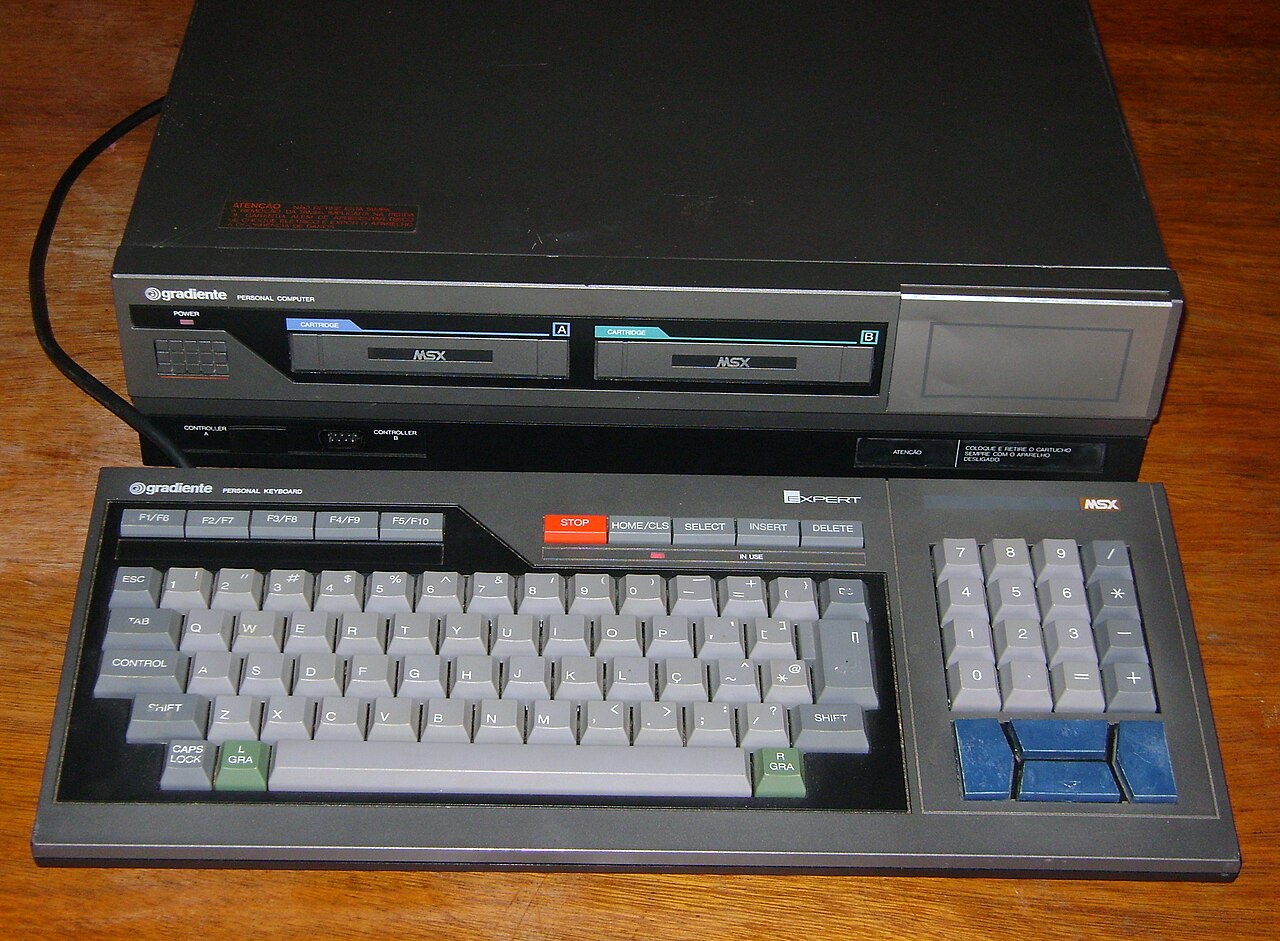
The microcomputer reserve created an industry of copies. Prológica’s CP 500, launched in 1982, was compatible with the Tandy TRS-80 Model III. Several firms sold Apple II compatibles, Microdigital’s TK90X copied the Sinclair ZX Spectrum, and in late 1985 two MSX computers appeared within about a week of each other, Epcom’s Hotbit and Gradiente’s Expert, the latter a clone of a Japanese National machine. Some of the copying went down to the code: Scopus’s operating system SISNE, an MS-DOS clone, was reported in 1987 to contain code copied from Microsoft’s. The machines were usually built from imported chips, since Brazil never established a semiconductor industry of its own, and a market in smuggled PCs grew beside the legal one.
By the figures its defenders liked to quote, it worked. Between 1980 and 1986 the earnings of national firms grew about 7.4 times, roughly 40 percent a year, and the microcomputer market grew by an average of 74 percent a year from 1984 to 1987. In the mid-1980s private Brazilian informatics firms spent 8 to 10 percent of their sales on technology work, against less than 1 percent for manufacturing industry as a whole. By 1989 the sector employed about 70,000 people directly, a third of them with university degrees. The professional bodies that grew up with it, among them the Brazilian Computer Society, founded in 1978, the manufacturers’ association ABICOMP and the data-processing professionals’ association APPD, were its strongest supporters.
The Informatics Law
When military rule was ending, the reserve’s supporters moved to put the policy beyond the reach of decrees. Congress passed the Informatics Law, Lei 7.232, unanimously, and Figueiredo signed it on 29 October 1984. It created a National Council for Informatics and Automation (CONIN), with eight seats for industry, users, workers, scientists, the press and lawyers, and kept SEI as its executive arm. Article 4 limited the control of imports of computing goods and services to eight years from publication. Article 12 defined a national company: incorporated and based in Brazil and permanently controlled by people resident there, with decision-making control, technological control, all of the voting capital and at least 70 percent of the total capital in Brazilian hands.
The law reached further than industrial policy. Among its principles it listed the protection of the secrecy of stored and processed data and of personal privacy, and the right of every citizen to see and correct information held about them in public or private databases, years before most countries had such rules. The deputy Cristina Tavares and the senator Severo Gomes carried it; the economist and senator Roberto Campos, the reserve’s most persistent opponent, filed a challenge to its constitutionality, which the Supreme Federal Court rejected on procedural grounds.
The Conflict with Washington
In September 1985 the United States opened an investigation of Brazil’s informatics policy under Section 301 of the Trade Act of 1974, the provision that let the President retaliate against unfair foreign trade practices. In October 1986 it found the policy unreasonable and a burden on American commerce, and suspended the case in part after Brazil made commitments.
The case reopened over an operating system. In November 1987 SEI refused to license MS-DOS for sale in Brazil, on the grounds that SISNE was an acceptable national substitute; Computer Business Review reported the ban on 12 November. The next day, 13 November 1987, Ronald Reagan announced that he intended to raise tariffs on Brazilian exports to offset an estimated $105 million in lost sales of American firms and to ban imports of Brazilian computer products covered by the reserve, citing Brazil’s refusal to license an American software product because a domestic firm made a functionally equivalent one. Reagan said the sanctions would be lifted if Brazil reversed its decision. Software had already been the sharpest part of the case: on 30 June 1987 the White House had suspended that part after the Chamber of Deputies passed a software copyright bill.
Dead End: An Industry That Could Not Leave Home
The reserve’s critics had argued from the start that it made computers expensive. Late in the 1980s Brazilian prices were about twice those in the United States, and product generations still lagged the world by at least two years after a decade of protection. The policy had trained engineers but had not produced a product that sold outside Brazil, and Brazil had no chip industry, so every national computer depended on imported components that the reserve did not control.
The end came with democracy and an open economy. Fernando Collor, elected in 1989, opened the economy to imports, abolished SEI in 1990 and withdrew the second national informatics plan from Congress. A new Informatics Law in 1991, Lei 8.248, redefined a national company by majority capital alone, which allowed foreign firms to control the technology in joint ventures, and replaced the reserve with tax incentives for local production and research. The import controls expired as the 1984 law had prescribed, in October 1992. By the government’s own estimate, between 1989 and 1992 the local industry’s net earnings fell by 47 percent, its employment by 60 percent and its spending on research and development by 69 percent. What remained was an assembly industry building imported designs under the incentives of the new law.
📚 Sources
- Erber, Fabio S.: “The Political Economy of Technological Development: The Case of the Brazilian Informatics Policy,” in M. I. Bastos and C. Cooper (eds.), Politics of Technology in Latin America, Routledge, 1995 (GTE 1971, CAPRE 1972 and 1975–76, imports +600 percent 1969–74, fifteen projects and three selected in 1977, SEI 1979 under the National Security Council, unanimous 1984 law, US investigation September 1985, growth and R&D figures, prices about double, two-year lag, SEI abolished 1990, 1991 law, 1989–92 decline)
- Lei nº 7.232, de 29 de outubro de 1984, Presidência da República (articles 1, 2, 4, 6 and 12)
- Política Nacional de Informática, Wikipedia (Portuguese) (eight-year validity, Severo Gomes and Cristina Tavares, Campos’s challenge, ABICOMP/SBC/APPD, 70,000 jobs, expiry October 1992, Sharp of Brazil and Sid Informática)
- “A indústria de computadores: evolução das decisões governamentais,” Revista de Administração Pública, FGV (three firms chosen at the end of 1977: Sharp, Labo and Edisa; Fujitsu, Nixdorf and Logabax licences)
- “The Brazilian Market Supply for the Production of Computer Goods,” Revista da Faculdade de Direito, USP (CAPRE 1972 and 1976; five firms selected in 1977, one state-owned and four private)
- “Brazil’s Computer Market Reserve: Democracy, Authoritarianism, and Ruptures,” ResearchGate (minicomputer competition, exclusion of multinationals, large systems left to IBM and Burroughs)
- “Brazil bans MS-DOS from being sold in Brazil,” Computer Business Review (Tech Monitor), 12 November 1987 (SISNE, Scopus, copied code, Yeutter)
- Reagan, Ronald: “Statement on Trade Sanctions Against Brazil,” 13 November 1987, American Presidency Project (Section 301 from September 1985, October 1986 finding, $105 million)
- “Fifty years ago the first computer designed and built in Brazil was presented,” Government of Brazil, 2022 (the Navy’s Ferranti FM-1600B computers, national sovereignty) and Niterói-class frigate, Wikipedia (ordered 1970, Vosper Thornycroft)
- “The US and Brazil: anatomy of a trade dispute,” Christian Science Monitor, 27 March 1987 and White House statement on the Brazil Section 301 case, 30 June 1987, American Presidency Project (software part suspended after the Chamber of Deputies’ copyright bill)
- CP-500, Wikipedia (Prológica, 1982, TRS-80 Model III compatible) and Gradiente Expert, Wikipedia (December 1985, Hotbit a week earlier, clone of the National CF-3000)
- SISNE plus, Wikipedia (DOS clone by Itautec and Scopus, dropped after imports were allowed)
- Heinz Nixdorf MuseumsForum blog, “Computer in Brasilien” (6 September 2022) (Cobra’s founders, Prológica, Microdigital, Labo)
- Image: Gradiente Expert Brazil.jpg by Carlosar (CC BY-SA 3.0), via Wikimedia Commons