Peter Weibel
Abstract
Peter Weibel (1944–2023) was an Austrian artist, theorist and curator who started in the Vienna action art of the 1960s, made video and computer works from 1969, and spent most of his later life building institutions for media art: the Institute for New Media in Frankfurt, the artistic direction of Ars Electronica in Linz, and from 1999 until his death the ZKM Center for Art and Media in Karlsruhe. At the ZKM he put the history of algorithmic and computer art into a museum setting, with exhibitions such as The Algorithmic Revolution (2004–2008), retrospectives for the computer-art pioneers, and Open Codes (2017–2019), which drew more than 200,000 visitors.
Logic and Provocation
Weibel was born in Odessa on 5 March 1944 and grew up in Ried im Innkreis in Upper Austria. After a year of French and film studies in Paris he enrolled in medicine in Vienna in 1964, then switched to mathematics with a focus on logic. He did not finish a degree. For years his CV listed a dissertation he had never defended, which the plagiarism researcher Stefan Weber later called the “Weibel dissertation-doctorate paradox”.
He began as a visual poet in 1964 and from 1965 moved from the page into performance, working with language, his own body, film and tape. He was part of the Vienna Actionist scene, attended the Destruction in Art Symposium in London in 1966, and on 7 June 1968 took part in the “Kunst und Revolution” action at the University of Vienna, where he gave a lecture titled “Was tun?” while holding a burning glove. From 1967 he developed an “expanded cinema” with VALIE EXPORT, Ernst Schmidt jr. and Hans Scheugl.
Video and Computers
From 1969 Weibel made video works and installations; in 1972 the Austrian broadcaster ORF aired his teleaktionen in its programme Impulse. In 1978 he co-founded the band Hotel Morphila Orchester with Loys Egg. He took part in documenta 6 in 1977, and in the 1990s he made interactive computer installations.
He taught from 1976, among other places at the University of Applied Arts in Vienna, in Kassel and in Halifax, and from 1984 to 1989 at the Center for Media Study of the State University of New York at Buffalo. In 1989 he set up the Institute for New Media at the Städelschule in Frankfurt and ran it until 1994.
Linz, Graz and Venice
In 1986 Weibel became artistic advisor to Ars Electronica in Linz, the festival for art and technology that Herbert W. Franke had co-founded in 1979, and from 1992 to 1995 he was its artistic director. In parallel he was chief curator of the Neue Galerie in Graz from 1992 and commissioner of the Austrian pavilion at the Venice Biennale from 1993 to 1999.
The ZKM
In January 1999 Weibel took over the ZKM Center for Art and Media in Karlsruhe, founded in 1989 and housed since 1997 in a former munitions factory (see Computer Science Locations). He ran it for 24 years, until his death.
The Algorithmic Revolution: On the History of Interactive Art, which he curated with Dominika Szope, Margit Rosen and Sabine Himmelsbach, opened at the end of October 2004 and stayed on view until January 2008. It drew on the ZKM collection to trace how rule-based procedures entered the fine arts, music, design and architecture; Weibel dated the algorithmic revolution to around 1930 in science and around 1960 in art. The ZKM went on to give the computer-art pioneers museum retrospectives, Herbert W. Franke in 2010–2011 and Manfred Mohr in 2013 (see Computer Art and Generative Art).
Open Codes, which opened in October 2017 and ran until June 2019, set out to show how digital codes and data systems shape society, the economy, politics and law. One of its parts took its title from an installation by Weibel and Christian Lölkes, The World as a Field of Data. More than 200,000 people saw it in Karlsruhe, and versions travelled to Berlin, Shanghai, Bilbao and Mumbai. In 2018 the German Chapter of the ACM interviewed Weibel and the computer graphics researcher Bernd Lintermann at the ZKM for its 50th anniversary, and the two spoke on algorithms in media art at the chapter’s Heidelberg symposium that September. In the interview Weibel traced the digital age back to Galileo and Newton’s conviction that the book of nature is written in the language of mathematics, and from there to George Boole, who formalised thought as algebra.
Last Years
Weibel received the Austrian Art Prize for Media Art in 2017 and the Lovis Corinth Prize in 2020. In April 2022 he initiated an open letter, published in Emma, urging Chancellor Olaf Scholz to stop arms deliveries to Ukraine, and in February 2023 he was among the first signatories of the “Manifest für Frieden”. He died in Karlsruhe on 1 March 2023, four days before his 79th birthday, and was buried at the Vienna Central Cemetery.
📚 Sources
- Wikipedia: Peter Weibel (birth, studies, Destruction in Art Symposium, teaching, Ars Electronica, Venice, ZKM from January 1999, awards, death)
- Wikipedia (German): Peter Weibel (Künstler) (Ried im Innkreis, no completed degree and the dissertation controversy, “Kunst und Revolution” 1968, expanded cinema, video from 1969, teleaktionen 1972, Hotel Morphila Orchester, Buffalo, Frankfurt, Neue Galerie Graz, documenta 6, Austrian Art Prize 2017, the 2022 and 2023 letters, burial)
- ZKM: “The ZKM mourns the death of Peter Weibel” (March 2023) (death in Karlsruhe on 1 March 2023, 24 years at the ZKM, funeral in Vienna)
- ZKM: Algorithmic Revolution, exhibition 31 October 2004 – 6 January 2008 and ZKM: Algorithmic Revolution event page (2006) (dates, curators)
- Rhizome: “The Algorithmic Revolution” (25 August 2005) (scope, Weibel’s dating of the revolution)
- ZKM: Open Codes. Living in Digital Worlds (concept, more than 200,000 visitors October 2017 to June 2019, Berlin, Shanghai and Bilbao)
- ZKM: #insideOpenCodes, “The World as a Field of Data” (installation by Weibel and Lölkes)
- ZKM: Visitor success in Indian Mumbai (Open Codes in Mumbai, February 2019)
- Mensch Sein mit Algorithmen: Marc-Oliver Pahl interviewt Peter Weibel und Bernd Lintermann (13 May 2018) (German Chapter of the ACM)
- German Chapter of the ACM: “Our symposium 2018 was a great success!” (22 January 2019) (Weibel and Lintermann at the Heidelberg symposium)
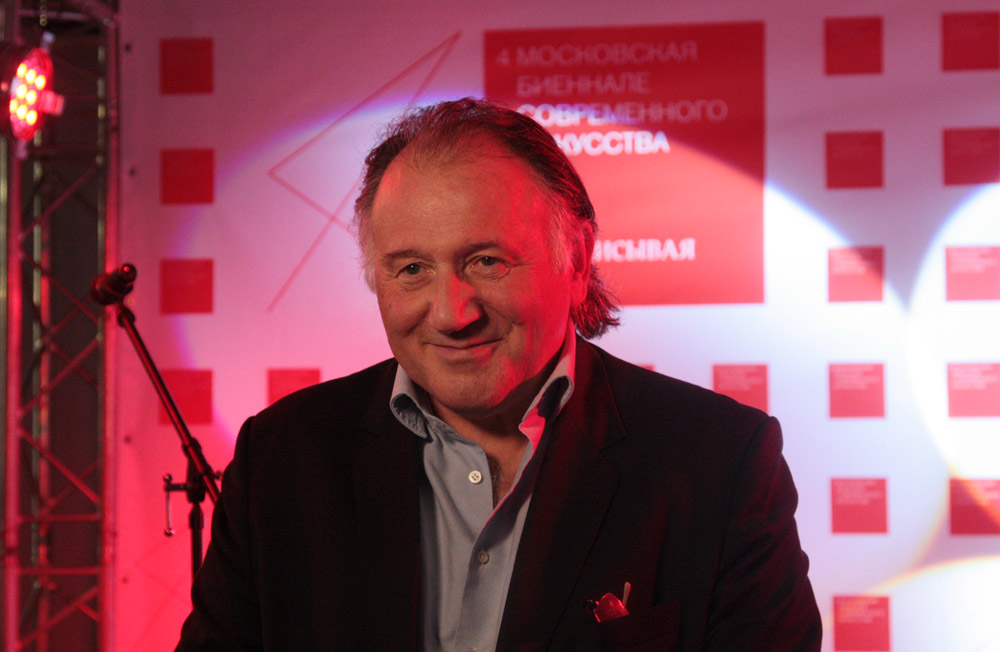
- Image: Peter Weibel Петер Вайбель (12694678055).jpg by Valerij Ledenev from Moscow, Russia (CC BY-SA 2.0), via Wikimedia Commons