ERMA and the Bank Computer
Abstract
In 1950 Bank of America, then the largest bank in the world, was drowning in checks: its checking accounts grew by 23,000 a month, and branches closed at 2 p.m. so that bookkeepers could finish posting. No office-machine maker wanted to build a machine for the job, so the bank hired the Stanford Research Institute in Menlo Park. SRI’s engineers persuaded the bank to give every account a number, printed the numbers on the checks in magnetic ink that both people and machines could read, and built ERMA, a 25-ton bookkeeping computer that the bank unveiled on 22 September 1955. General Electric built the production version, its first step into the computer business. By 1966 twelve ERMA centers handled more than 750 million checks a year, and the magnetic-ink numbers SRI designed are still printed along the bottom of checks.
The Check Crisis
After the Second World War Americans wrote checks in numbers no bank had planned for, and Bank of America, built by A. P. Giannini on branch banking across California, wrote more than most. An experienced bookkeeper posted about 245 accounts an hour, some 2,000 a day. The bank’s checking accounts were growing by 23,000 a month, and its branches had to close their doors at 2 p.m. to finish the day’s posting. The senior vice president S. Clark Beise saw that check handling would cap the bank’s growth, and the business-equipment makers he approached saw no reason to risk money on a new kind of machine.
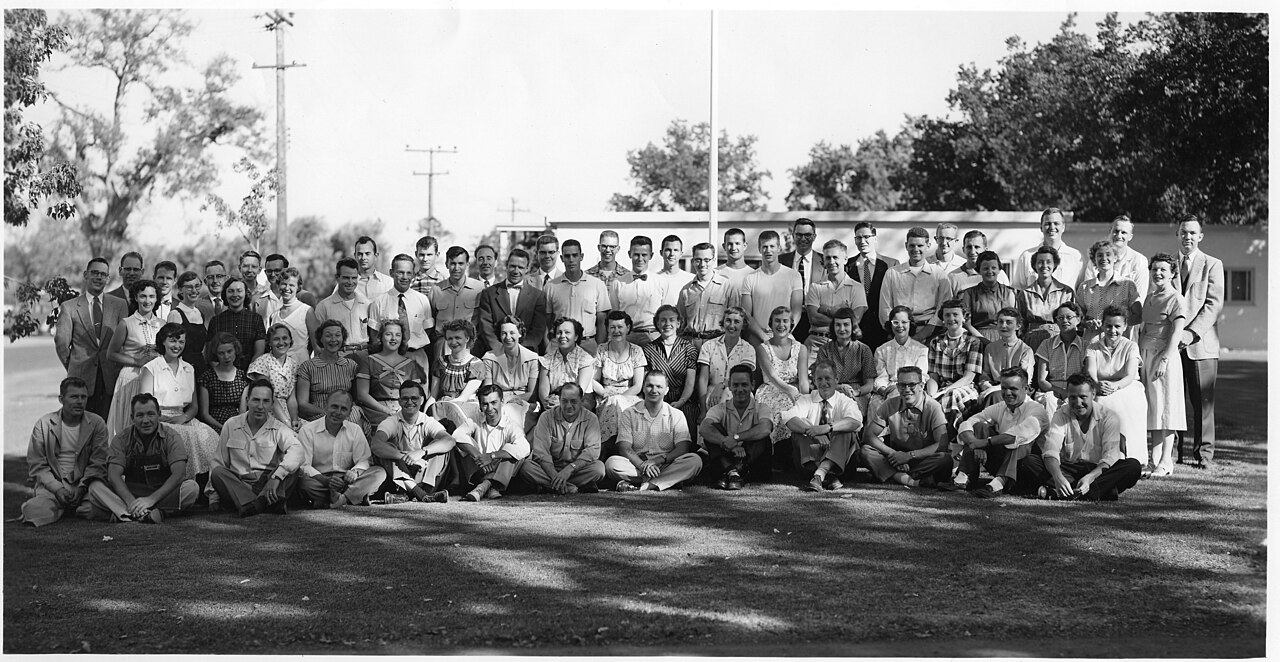
SRI, founded in 1946 by Stanford University and a group of businessmen, had no endowment and lived on contract work. Through Weldon Gibson and the director of engineering, Thomas Morrin, Beise arranged for SRI to act as the bank’s research department. In July 1950 the bank asked for a feasibility study of an electronic bookkeeping machine. The technical lead was Jerre Noe, who with Oliver Whitby ran the early studies; the bank called the young SRI engineers its “whiz kids,” and its representative Charles Conroy all but lived with them to teach them banking.
Account Numbers
The first change SRI asked for involved no electronics. Bank of America kept its accounts in alphabetical order, so every new customer meant reshuffling the ledgers, and blank checks carried no identification at all and were passed around for anyone to fill in. SRI proposed giving each account a number, adding new accounts at the end of the list, and printing the number on the customer’s checks. Once the bank agreed, the machine only had to read a number, not a name. The feasibility report of September 1950 concluded that an Electronic Recording Machine, ERM, could be built.
The bank paid $15,000 for six months of further study from November 1950 and another $5,000 in April 1951, and the interim report arrived on 30 April 1951. Still no manufacturer would take on the construction, so in January 1952 SRI agreed to build a pilot machine itself: up to $850,000 over four years, plus $25,000 for subcontractors. Engineers later estimated the whole project’s cost at about $10 million.
Magnetic Ink
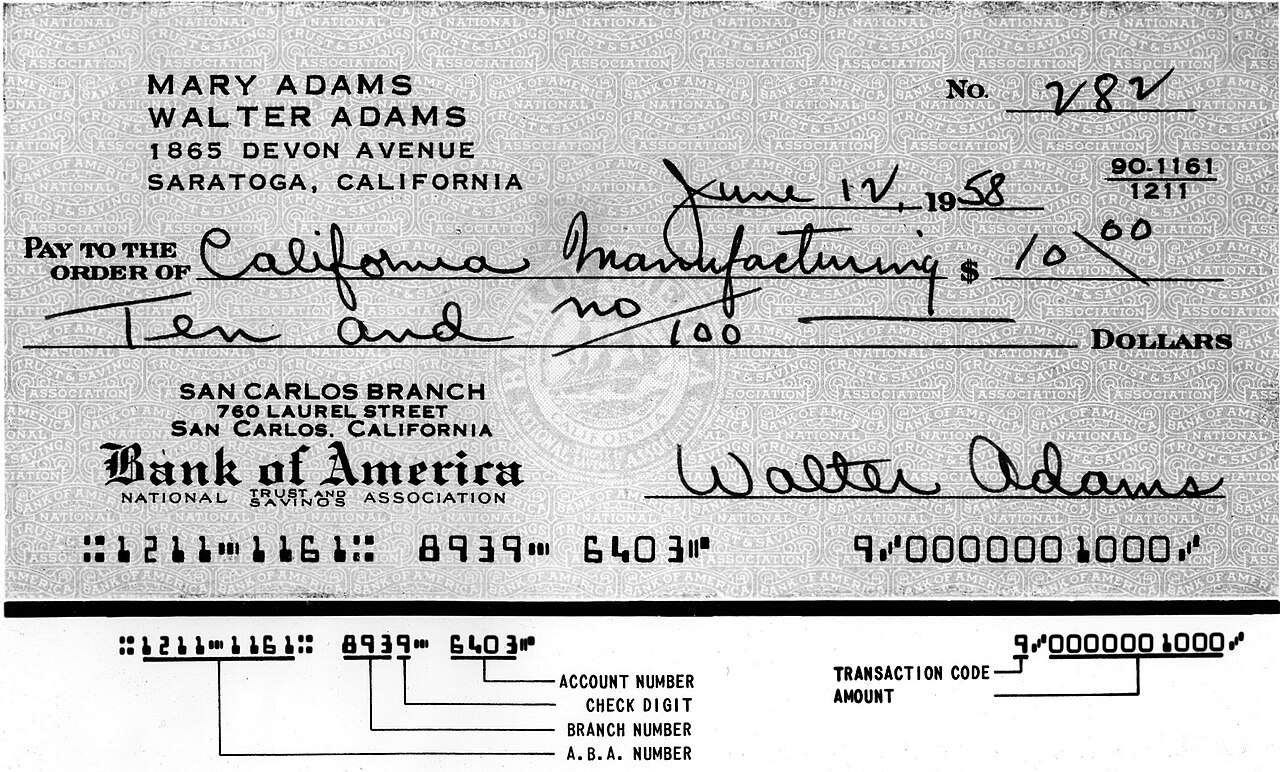
Beise refused to have check data copied onto punched cards; the machine had to read the check itself. SRI tried an optical reader from a company in Arlington, Virginia, but bank stamps and customers’ pens spoiled the characters, and the bar codes it then printed on the backs of checks could not be read by a person when the machine failed. In early 1953 Morrin told Beise that magnetic ink was the answer. Ken Eldredge, head of SRI’s control systems laboratory, designed numerals and special symbols printed in magnetic ink on the front of the check, readable by eye and by a magnetic head scanning across them; the young engineer Phil Merritt built the waveform-recognition circuits. This became Magnetic Ink Character Recognition (MICR). Bill Noon built the sorter, which took checks of almost every size, folded, torn or stapled, and handled about ten a second with fewer than one error in 100,000.
The banking industry adopted the idea. In July 1956 the American Bankers Association’s technical subcommittee on check handling, after two years of evaluating every known reading method, recommended MICR as the common machine language for banks. The specifications and the type font were settled by 1959, and by 1967 virtually every check carried them. Eldredge’s patent for the reading system, filed on 6 May 1955 and assigned to General Electric, was granted on 12 September 1961 as US Patent 3,000,000.
ERMA Day
The machine kept changing as the engineers improved it, and in the spring of 1955 the bank’s managers declared the design finished “as is” and set a public announcement for September. The engineers worked in shifts around the clock; by the end so many undocumented changes had been wired in that the logic diagrams no longer matched the machine. The finished computer had more than a million feet of wire, about 8,000 vacuum tubes and 34,000 diodes, two magnetic drums for the account balances, twelve tape drives, five operator consoles with readers, the sorter and a high-speed printer. It weighed about 25 tons and drew more than 80 kilowatts. It was not a stored-program computer: its program was wired.
The bank’s public relations office found “ERM” too technical and renamed the machine ERMA, Electronic Recording Machine, Accounting, to the engineers’ dismay. On 22 September 1955, “ERMA Day,” Beise, by then president of the bank, and Morrin presented it at SRI to journalists bused in from San Francisco, including writers from The New York Times, Life, Fortune, Newsweek and Business Week. The press kit called it “the biggest single advance in bank account bookkeeping in the history of banking” and promised that although nine operators would replace more than fifty bookkeepers, nobody would lose a job. The sorter was still unreliable; Morrin waited for an engineer at the back of the room to give a thumbs-up before he started it. The demonstration worked. At a private showing for SRI staff that evening, the sorter threw checks all over the room.
General Electric
Twenty-four companies wanted to build the production machines, and in 1956 General Electric won; it was GE’s entry into computers. GE redesigned ERMA with transistors and magnetic-core memory, technologies that had been too immature when SRI started, and SRI supported the transfer until 1957 or 1958. GE’s programming lead was Joseph Weizenbaum, under whom the project shifted from wiring to software. The first GE-built ERMA went into service at Bank of America in 1959, and the bank formally accepted the system on 14 September 1959. About thirty more followed within two years. By 1966 twelve regional ERMA centers served all but 21 of the bank’s 900 branches and processed more than 750 million checks a year, close to the volume SRI had projected for 1970. The ERMA machines were replaced in the early 1970s; GE sold its computer business to Honeywell in 1970 (see The IBM Mainframe Era).
The automation let Bank of America launch BankAmericard, a general-purpose credit card, in 1958; licensed to other banks from 1966, it was renamed Visa in 1976. Weizenbaum later regretted his part. In 1985 he told MIT’s student newspaper that without the computer the banks “might have had to decentralize, or they might have had to regionalize in some way,” and that computers had spared them the need for a social invention.
📚 Sources
- Amy Weaver Fisher and James L. McKenney, “The Development of the ERMA Banking System: Lessons from History”, IEEE Annals of the History of Computing 15:1 (1993) (PDF) (Beise, Gibson, Morrin, Noe and Whitby, account numbers, the 1953 magnetic-ink decision, Eldredge, Merritt, Noon, the ABA recommendation of July 1956, standards by 1959 and universal by 1967, the “as is” freeze, the machine’s components, the renaming, ERMA Day on 22 September 1955, the press kit, the thumbs-up and the evening showing)
- SRI International, “Electronic Recording Machine, Accounting (ERMA)”, Timeline of Innovations (archived 2013) (245 accounts an hour, 23,000 new accounts a month, 2 p.m. closing, July 1950 study, $15,000 and $5,000, interim report 30 April 1951, the optical reader, the sorter’s rate and error figure, 25 tons and 80 kW, 24 bidders, GE in 1956, the first GE system in 1959, 12 centers and 750 million checks by 1966, about $10 million)
- Hannah H. Kim, “ERMA’s whiz kids”, Increment 11 (November 2019, archived) (SRI’s funding model, Conroy, the wired program, Weizenbaum at GE, BankAmericard 1958, Visa 1976, the 1985 Weizenbaum quote)
- CHM This Day in History, 28 January (the January 1952 pilot contract, up to $850,000 plus $25,000, the $10 million estimate) and 14 September (acceptance in 1959)
- Wikipedia: Electronic Recording Machine, Accounting (GE’s transistor and core redesign, GE’s sale to Honeywell in 1970, replacement in the early 1970s)
- Kenneth R. Eldredge, “Automatic reading system”, US Patent 3,000,000 (filed 6 May 1955, granted 12 September 1961, assigned to General Electric)
- Image: ERMA Team.jpg by SRI International (CC BY-SA 3.0), via Wikimedia Commons
- Image: Check with MICR.jpg by SRI International (CC BY-SA 3.0), via Wikimedia Commons